

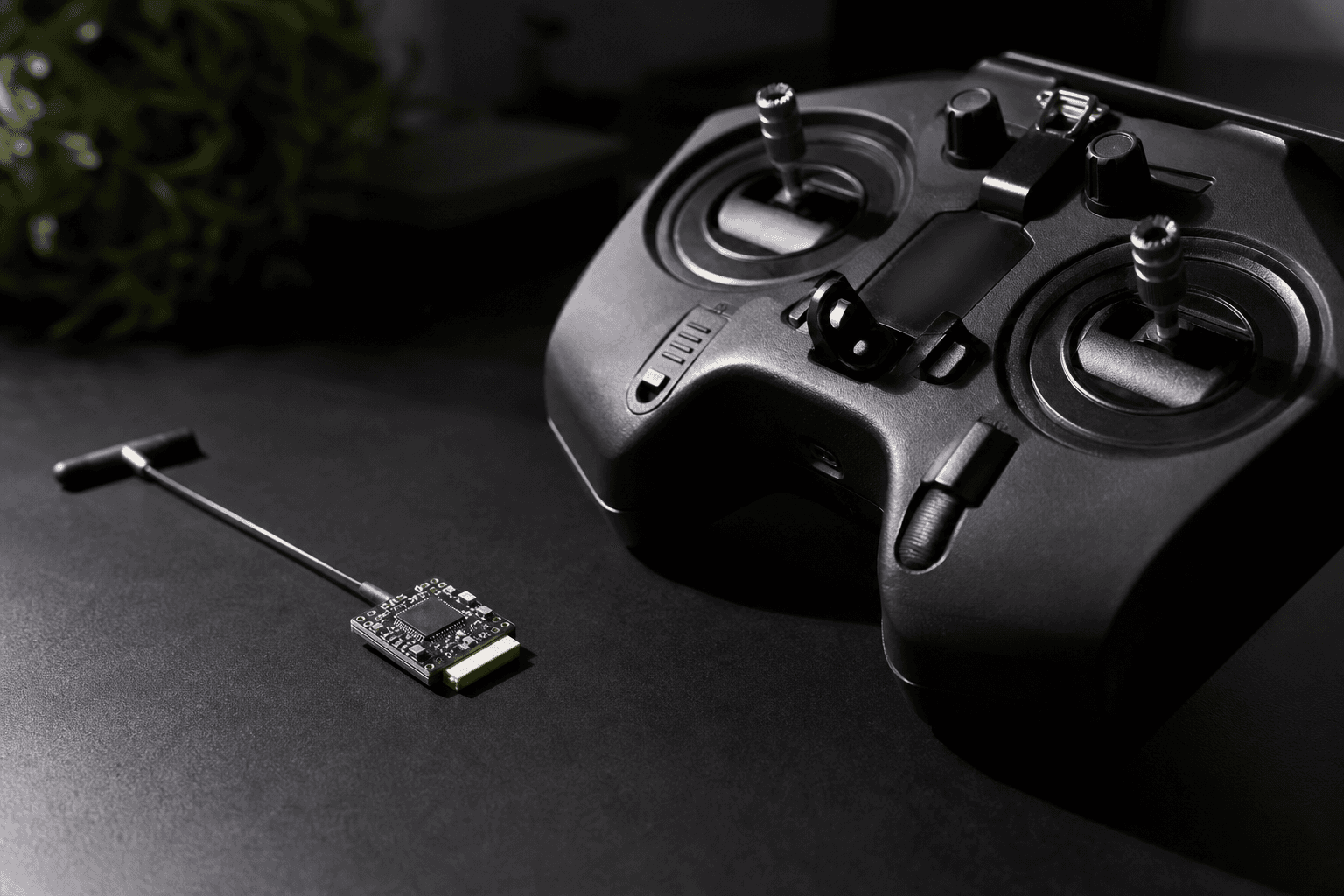

ExpressLRS (ELRS) is an open-source radio control link. In 2026 it's the default for most new whoops and hobby radios in India. If your sticks are talking to the quad, that conversation is probably ELRS, not one of the closed, brand-locked protocols beginners used to buy by accident.
It isn't video (that's the VTX and goggles). ELRS is control: throttle, yaw, pitch, roll, arming and modes. Low latency, long range and a huge range of cheap hardware are why new kits ship with it.
Why pilots care
| Benefit | What it means in practice |
|---|---|
| Low latency | Stick feel stays connected for freestyle and whoop gaps |
| Strong range for its power | Park and field flying without RF drama |
| Cheap receivers and modules | Spares from many brands, not boutique parts |
| EdgeTX Lua script | Packet rate, power and telemetry set from the radio |
| Open source | Free updates from the ELRS Configurator; no vendor lock |
Vs Crossfire in 2026: Crossfire vs ELRS. Whoop RX specifics: ELRS receiver for whoops India. Full link checklist: ELRS link budget and setup.
What you must match
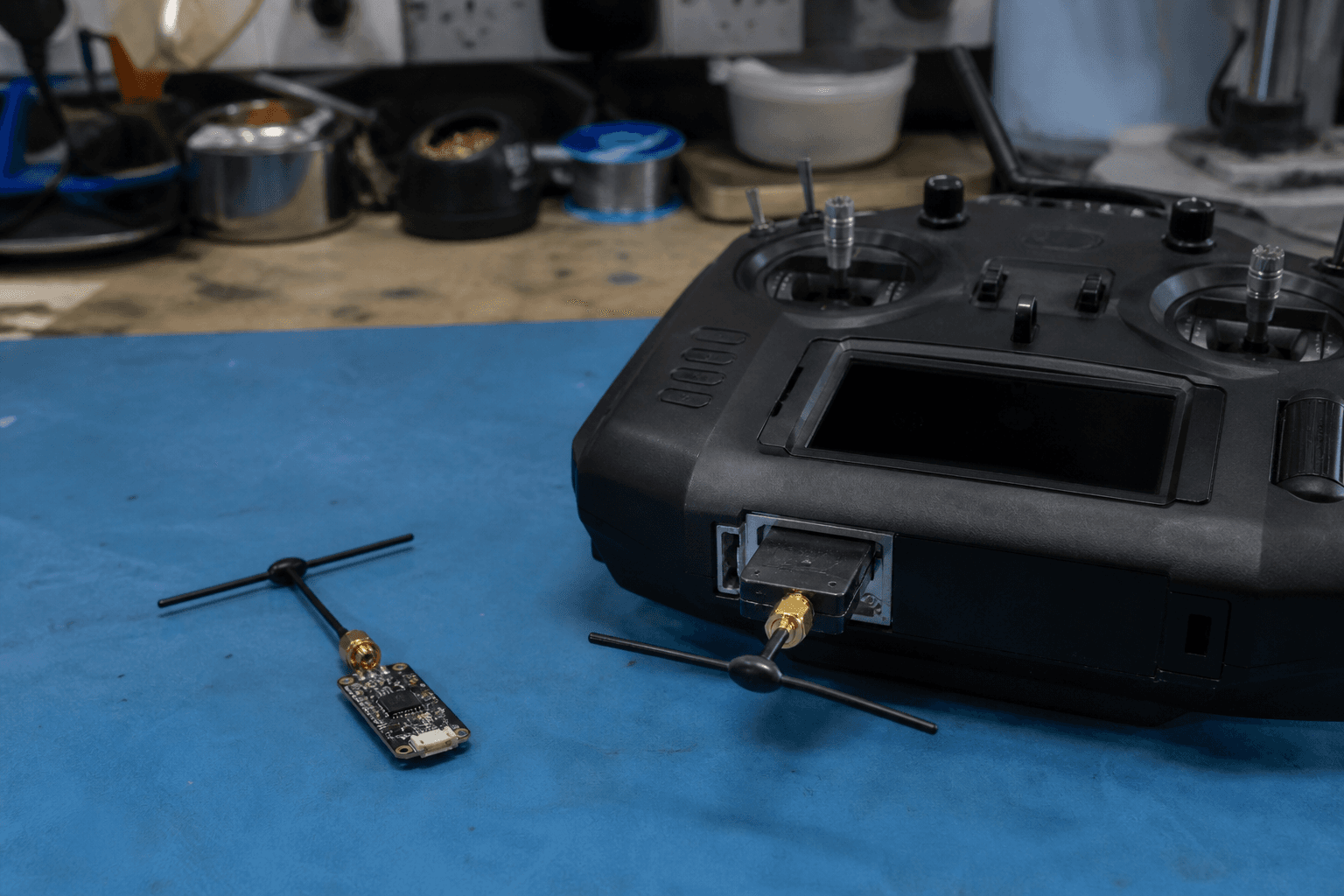
Radio TX (built-in ELRS or external module) and craft RX must both speak ELRS. Binding pairs them.
ELRS shopping rule
□ Radio has ELRS built in (or a module bay + ELRS module)
□ Whoop / quad is an ELRS BNF or has an ELRS RX
□ Same frequency band (2.4 GHz with 2.4 GHz)
□ Same major version (3.x with 3.x; SPI receivers need Betaflight 4.4+ for 3.x)
□ Same bind phrase on TX and RX if you use one
□ Antenna intact: no crushed whoop antenna under the canopy
Bind walkthrough: how to bind an ELRS radio. Updating when things get weird: how to update ExpressLRS.
Frequency bands (India-relevant)
| Band | Typical use | Notes |
|---|---|---|
| 2.4 GHz | Most whoops and park flyers | Licence-exempt worldwide, including India; the default for micros |
| Sub-GHz (868 MHz in India) | Long-range builds | Use ELRS's IN866 regulatory domain, which keeps to India's licence-exempt 865–868 MHz band; the common 915 MHz setting isn't legal here. Different antennas and hardware; not a day-one whoop need |
Urban RF context: 2.4 GHz vs sub-GHz in urban India. On a tiny whoop, stay on the 2.4 GHz hardware your kit shipped with until you have a real range problem.
Beginner shopping rule
Buy ELRS radios and ELRS BNFs. Don't buy a quad on a dead-end protocol because a marketplace listing was ₹800 cheaper.
| Buy | Skip for your first quad |
|---|---|
| A known-brand ELRS radio (RadioMaster, BetaFPV and similar) | A random "FPV remote" with no protocol named |
| An ELRS whoop BNF | Mystery receiver clones |
| Matching versions and bind phrase | Assuming "it'll just work" across major versions |
Radio choice: how to choose an FPV radio · FPV radio for beginners India. EdgeTX basics: set up EdgeTX · gimbals and EdgeTX.
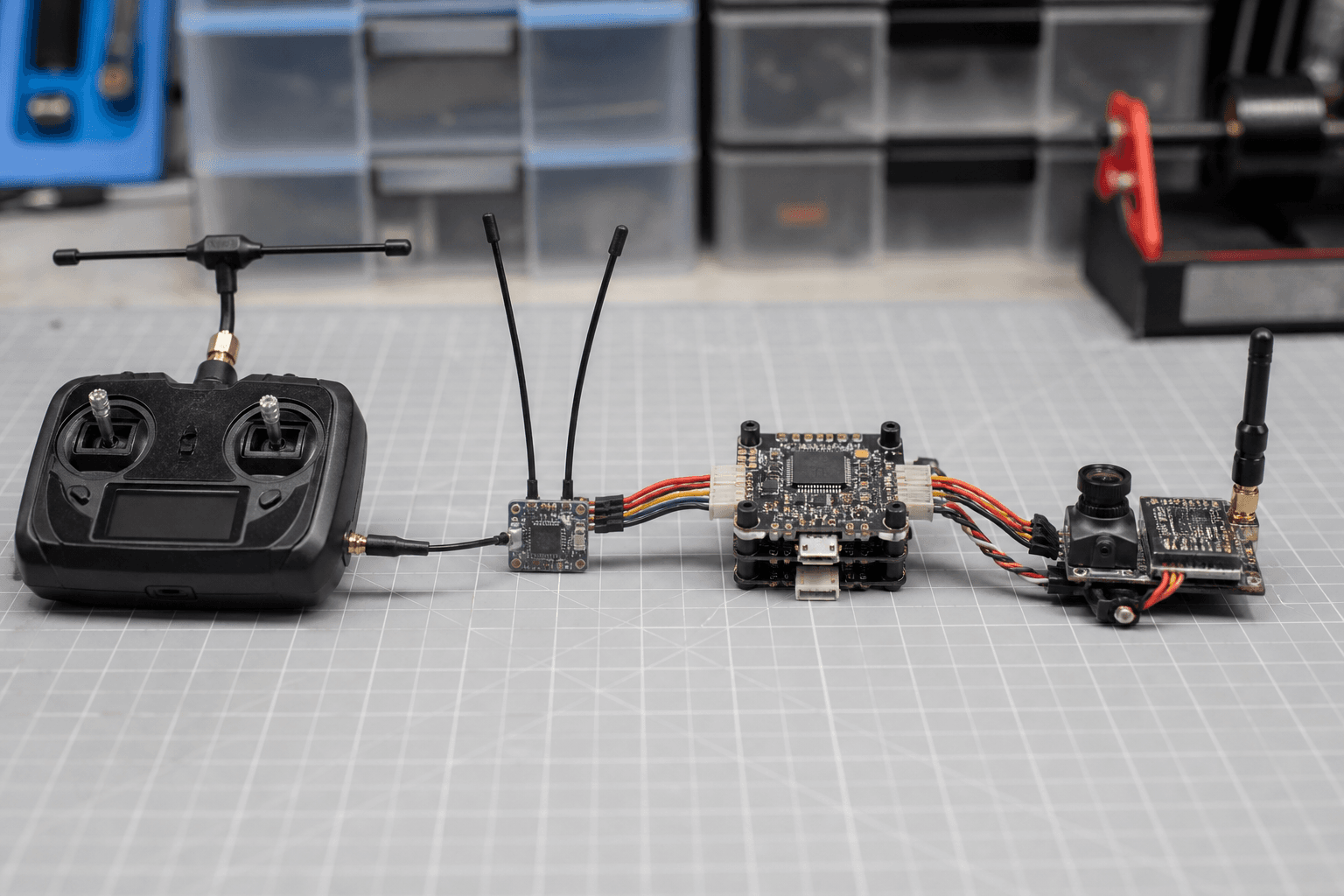
How ELRS fits the rest of the stack
| Layer | Example |
|---|---|
| Control link | ExpressLRS |
| Stick layout | Mode 2 - what is Mode 2 |
| Flight controller modes | Angle / Acro in Betaflight |
| Video | Analog or HD - separate from ELRS |
Confusing ELRS with video is a common new-pilot mix-up. Bad video doesn't mean bad ELRS, and a failsafe doesn't mean your VTX channel is wrong.
Failure modes
| Symptom | Likely ELRS issue | Next step |
|---|---|---|
| No bind | Bind phrase or major version mismatch | Match versions; re-flash or re-enter the bind phrase |
| Bind then immediate failsafe | Antenna, power, wrong model | Check antenna; link checklist |
| Telemetry weirdness | Packet rate / telemetry ratio | Lua adjust; do not panic-tune PIDs |
| Works on bench, dies at range | Power level / interference | Raise TX power carefully; check RX antenna |
| One model works, new whoop does not | Wrong model / receiver UART | Confirm BF serial / SPI RX config |
Receiver architecture: UART vs SPI. Failsafe behavior: failsafe scenarios.
India notes
Whoops and pocket-size radios sold in India almost all use ELRS now. That's good for community help: someone at a city meetup can help you bind. Prefer listings that say ELRS in the title. Practise while the radio ships: /sim (Mode 2).
Communities: FPV shops and communities by city.
Practical first-week ELRS path
- Buy an ELRS radio + ELRS whoop (or a kit that's already paired).
- Charge packs safely; confirm Mode 2.
- Bind with a bind phrase or the bind button/Lua flow; see the bind guide.
- Props-off motor check, then hover.
- Only later: packet rates, dynamic power and other experiments.
Bench
ELRS radios and whoops: the Bench. Compatible radio + RX + craft lists: Grind Lab. Stick time: /sim.
See also
- How to bind whoop to radio
- Analog VTX channels and power India - video is separate
- How to get started with FPV
FAQ
- What is ExpressLRS (ELRS)?
- ExpressLRS is an open-source radio control link used by most modern FPV gear. An ELRS radio talks to an ELRS receiver on the quad so you can arm and fly, with low latency and adjustable packet rates for whoops, freestyle and long range.
- Why do beginners want ELRS?
- ELRS is the default ecosystem for new whoop BNFs and radios. Choosing ELRS early avoids orphan protocols and makes the next airframe bind with less drama.
- Do I need to flash ELRS before my first flight?
- Usually not: a kit or BNF normally binds on its stock firmware. Still learn the basics of binding and bind phrases, and keep the radio and receiver on the same ELRS major version (for example both on 3.x) when you update later.
Discussion
Comments aren't open on this post yet. Share it with your build group, or start a thread on X.