

2.4 GHz vs 900 MHz in urban India

2.4 GHz ELRS is default for many builds; 900 MHz still wins conversations for penetration and noisy RF environments, neither ignores physics or Wi-Fi routers.
Indian pilots often fly a split life: open club fields on weekends, terrace tests and urban gaps on weekdays. Band choice that works on grass may fail behind concrete, and the opposite also happens when 900 MHz hardware is poorly installed.
This is practical RF habit, not legal advice. Verify band power and equipment rules for your situation. For link ecosystem choice, see Crossfire vs ELRS in 2026. For antenna mechanics, see antenna placement and ELRS checklist.
2.4 GHz in Indian cities
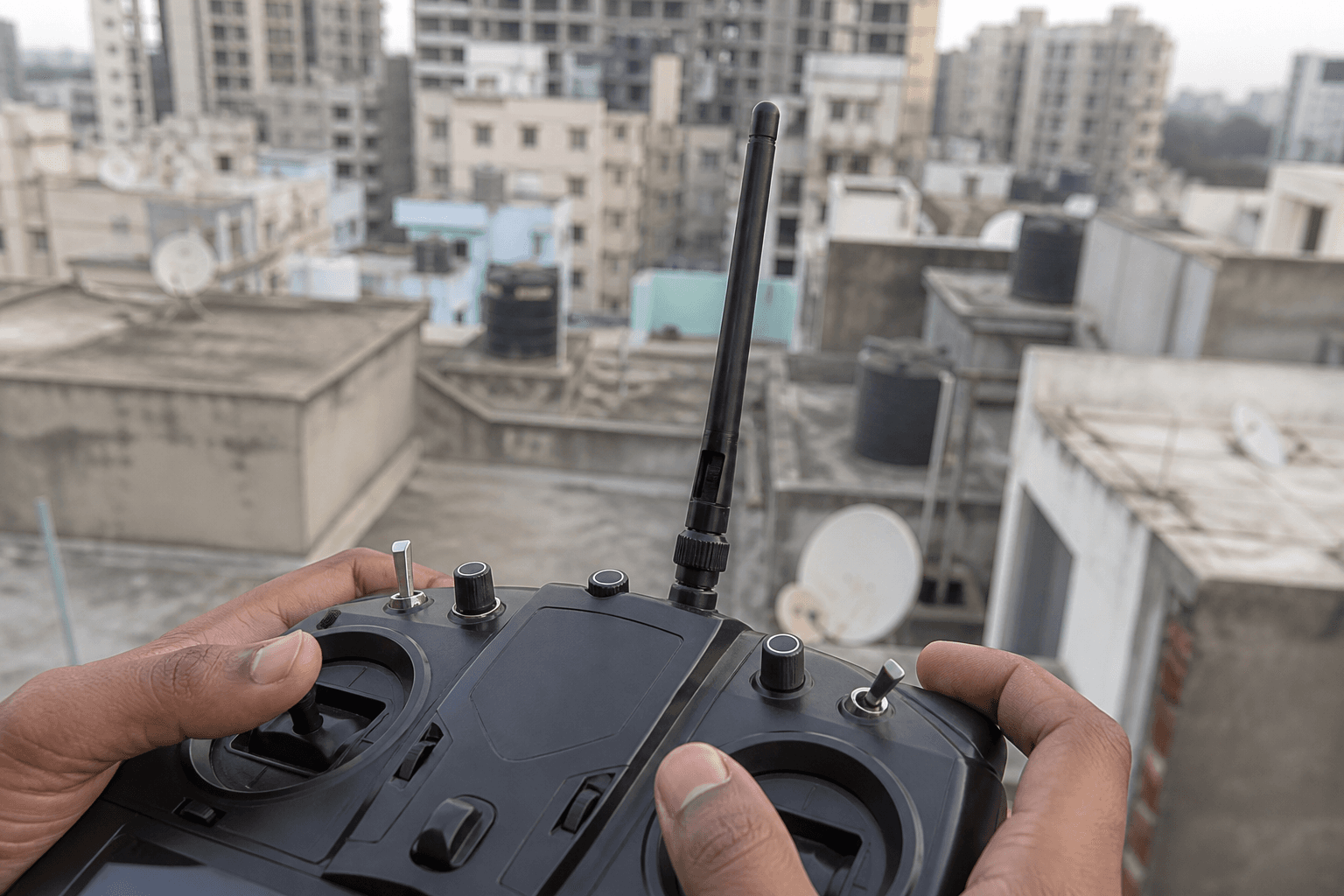
The 2.4 GHz band is crowded: Wi-Fi, Bluetooth, microwave ovens, and every other hobby pilot at the field. Outdoors on open ground, 2.4 GHz ELRS is often boring and fine with clean antennas.
Pain points:
- Dense apartment Wi-Fi on terraces, terrace flying guide describes worst-case RF, not best
- Multipath around concrete, metal railings, parked cars
- Body blocking when you fly behind yourself at low altitude in tight spots
- vtx desense (high-power 5.8 GHz vtx too close to the RX pigtail) and poor RX placement, not the band's fault
| Scenario | 2.4 GHz typical feel |
|---|---|
| Open club field | Strong default |
| Park with trees | Usually OK with LQ headroom |
| Urban terrace | Variable, test, don't assume |
| Indoor whoop | Size and antenna fit favor 2.4 |
900 MHz (868 MHz EU gear in India)
Potential strengths: better penetration in some environments; larger antennas; different interference floor than Wi-Fi clutter.
Trade-offs:
- Larger RX antennas on small frames, mechanical challenge
- Hardware cost and domestic stock varies, import vs domestic
- Regulatory awareness (India): 2.4 GHz is the clearly delicensed ISM band for low-power radio. 915 MHz (US-market Crossfire/ELRS) is not an Indian ISM band, it overlaps cellular allocations; do not use US 915 MHz gear here. 868 MHz EU modules are what Indian shops often sell for “900 MHz” systems; legality for hobby RC sits in a grey zone under WPC short-range device rules, not legal advice; verify current WPC/DGCA guidance or prefer 2.4 GHz if you want a clear band.
- Still fails with bent antennas and bad u.fl, band does not fix install
868 MHz is not magic through every wall. It is another tool with different trade-offs.
Antenna tips (both bands)
- Vertical orientation consistency on TX and RX, both antennas lying flat is a shared mistake
- Replace bent stubs after crashes, field repair kit spare
- Keep vtx coax away from RX pigtail on stack
- Goggle or radio module antennas: secure, not folded against carbon chair
Wiggle test on pigtails after crashes, same as video vtx in antenna placement.
Side-by-side practical table
| Factor | 2.4 GHz | 900 MHz |
|---|---|---|
| Antenna size on whoop | Smaller | Tighter fit |
| Urban Wi-Fi clutter | Present | Different profile |
| Hardware choice (2026) | Wide ELRS | Good but narrower |
| India domestic stock | Strong | Check before commit |
| "I already own 2.4 gear" | Fly it first | Migrate if data says |
Picking for your fleet
| Fly mostly | Bias |
|---|---|
| Open club fields | 2.4 simplicity |
| Urban proximity / marginal spots | Test 900 at your spot before fleet-wide swap |
| Whoops indoor | 2.4 size wins |
| Long range open sky | Either can work, install and LQ matter more |
Decision tree:
New build, open field pilot?
└─ 2.4 ELRS, done unless data says otherwise

Regular terrace / urban gap flying?
├─ Fix antennas and vtx/RX layout first
├─ Log LQ on OSD at problem spots
└─ If still thin margin → trial 900 on ONE quad

Entire fleet swap to 900?
└─ Only after one quad proved it at YOUR spots
Compare with Crossfire vs ELRS ecosystem, not MHz religion.
Field test protocol
1. Configure LQ on OSD
2. Fly known path at known height
3. Note LQ dips, map to geography (behind building, etc.)
4. Change ONE variable (antenna, orientation, band)
5. Repeat same path same day if possible
Summer heat: radios in direct sun, thermal throttling is rare but human fatigue is not; summer packing.
Video link is separate
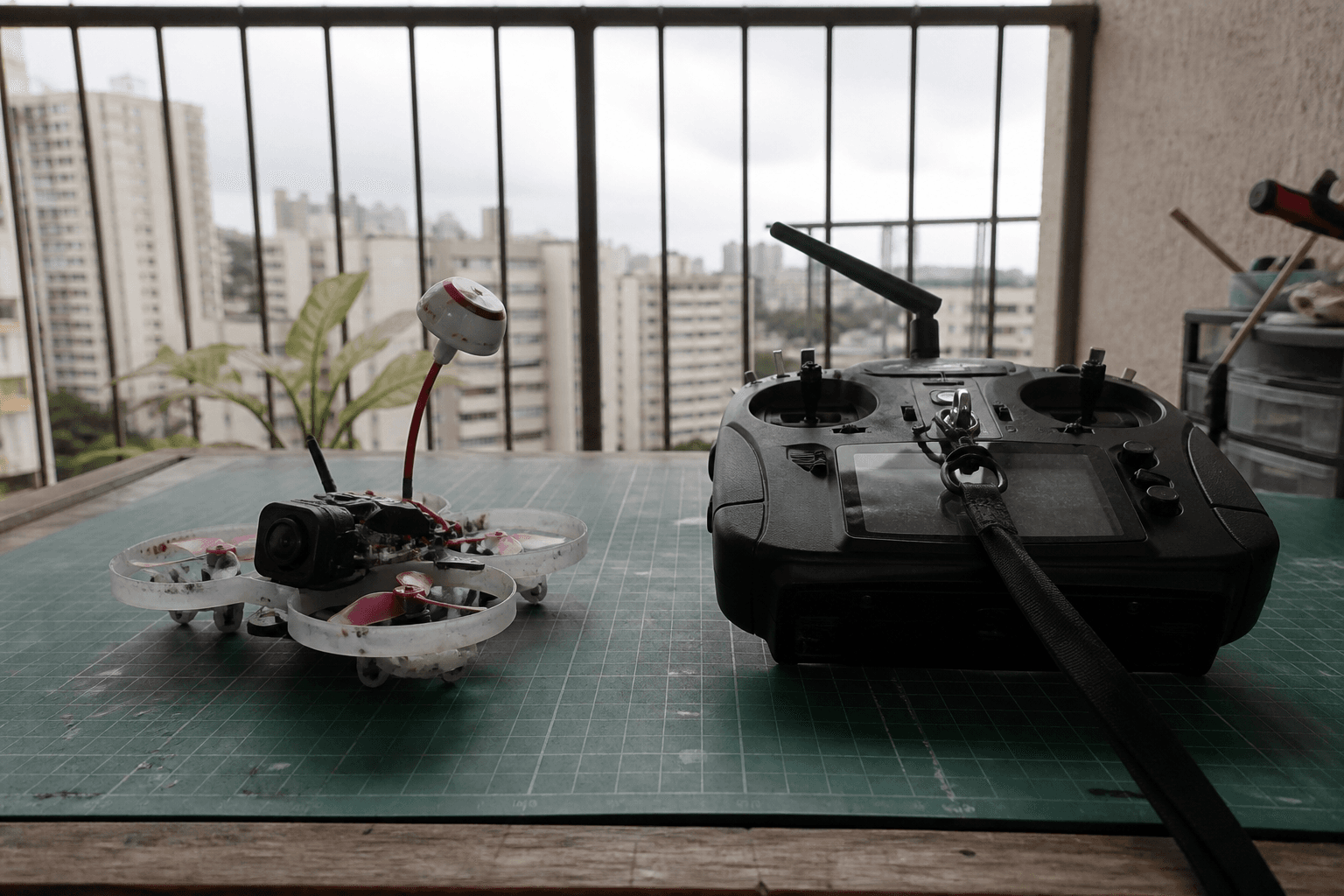
5.8 GHz analog or HD vtx does not fix 2.4 GHz control loss. Coordinate analog vtx power at meets separately from ELRS band choice.
Common mistakes
- Buying 900 MHz without testing 2.4 after basic antenna fix
- Flying urban lines with zero LQ awareness, failsafe untested
- Assuming forum "900 always wins in cities" without your terrace data
Pick the band that wins at your spots with your install, then stop shopping and fly.
Wi-Fi coexistence at home bench
Many pilots bind and configure on apartment desks surrounded by routers. 2.4 GHz bind can succeed on bench and feel different at field, not always band failure, but know your baseline. Power off nearby routers for critical bind troubleshooting if allowed; otherwise test in hallway with less clutter.
Fleet split (valid)
Running 2.4 on whoops and 900 on one long-range 5-inch is a valid split if you document which radio model maps to which RX. Confusion at arm time is the real risk, label quads on the arm.
Import lead time for 900 MHz gear
Some 900 MHz modules and receivers move through import channels slower than 2.4 domestic stock. If you decide to trial 900 after field tests, order before you are emotionally committed to a trip, courier roulette is not RF science.
Troubleshooting before you swap bands
| Symptom | Try first | Then consider |
|---|---|---|
| LQ dip behind body | Antenna orientation, fly path | , |
| LQ dip at one terrace corner | Multipath, change height | Log spot, avoid line |
| Failsafe after vtx swap | Separate vtx from RX pigtail | Antenna placement |
| Good bench bind, bad field | Test away from home Wi-Fi clutter | Field LQ log |
| Random LQ with bent stub | Replace RX antenna | Band swap last |
One-quad 900 trial (2 weeks):
Week 1, log LQ on OSD at problem spots with fixed 2.4 install
Week 2, same paths, same time of day, 900 on that quad only
Compare, fleet swap only if margin clearly improved
ELRS packet rate and urban noise
Higher packet rates can feel snappier but sometimes trade margin in noisy RF. If urban flying is your reality, log LQ at your usual rate before chasing forum presets. Pair rate changes with failsafe tests, margin and stage behavior move together.
Discussion
Comments aren't open on this post yet. Share it with your build group, or start a thread on X.