
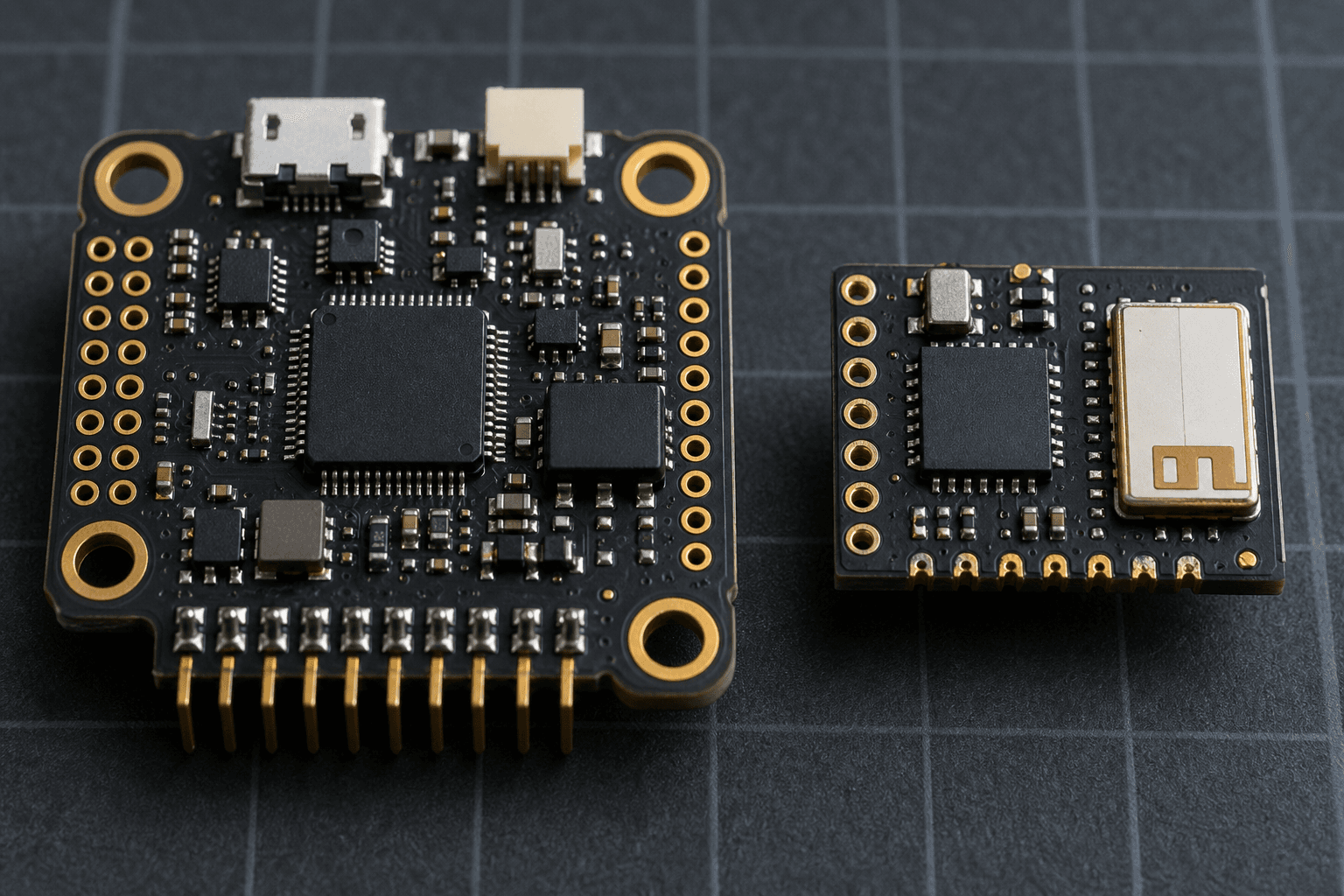

UART RX and SPI RX (express receiver on FC) both work, mixing them up on order day is a week of bind fails and UART inversion rabbit holes.
The receiver is the control link's endpoint on the quad. How it talks to the flight controller, separate UART wires vs SPI bus on dedicated pads, drives wiring, firmware target, and crash repair workflow.
For link budget and antennas after wiring is correct, see ELRS in the field. For new 5-inch wiring context, see building your first 5-inch.
UART receiver
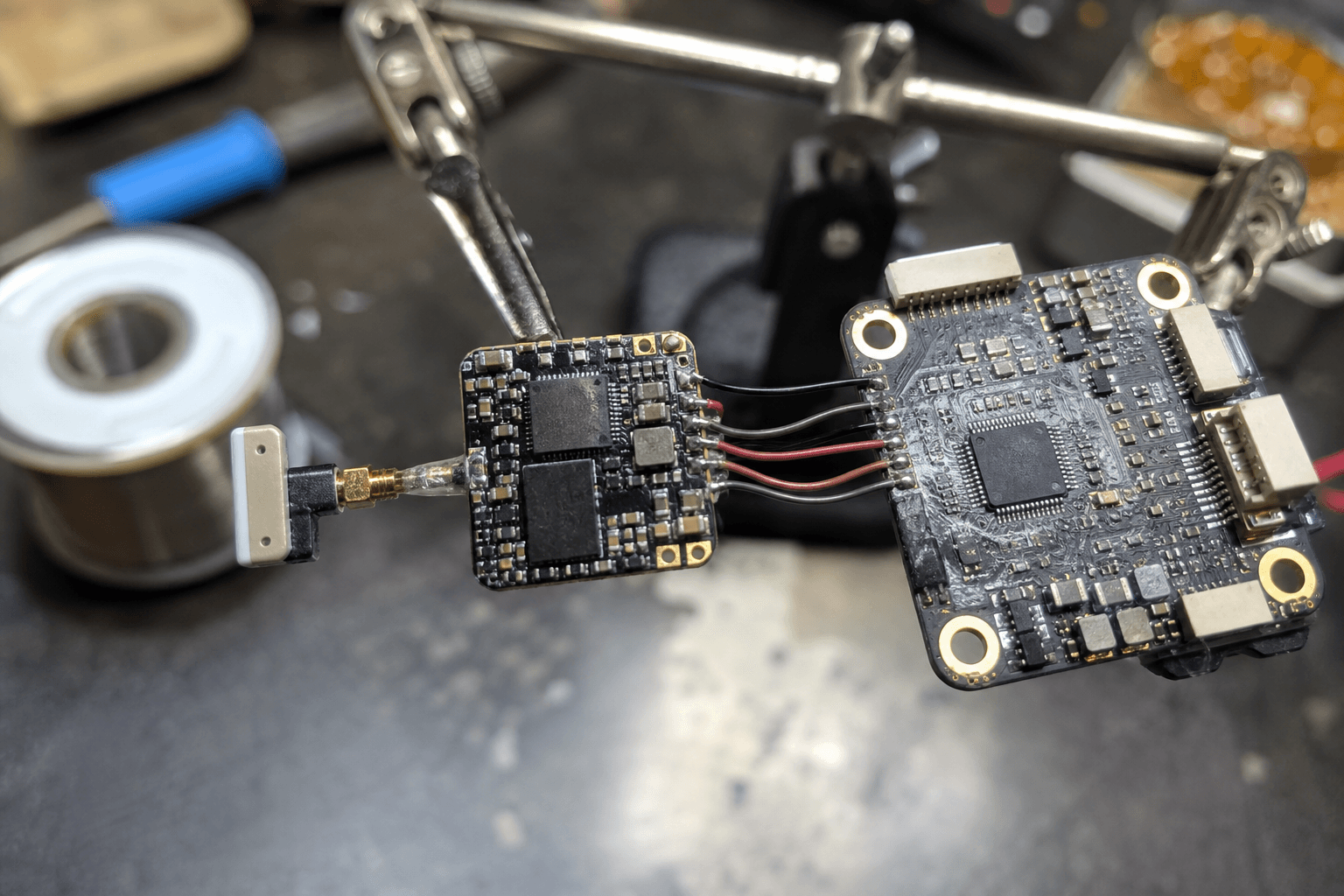
A separate RX wired to a UART pad on the FC.
Strengths:
- Flexible placement, mount RX away from vtx heat
- Easy replacement after crashes without swapping whole FC
- Clear wiring, TX/RX pads, sometimes inversion flags
Trade-offs:
- More wires, more weight on tiny builds
- More antennas to strain-relief
- Wrong UART or inversion = bind OK but garbage channels
Typical on: 5-inch freestyle, long-range, builds where RX may die alone.
SPI receiver
Plug-in or soldered dedicated pads on many whoop and all-in-one FCs: ELRS SPI receivers are common on micro stacks.
Strengths:
- Compact; great for tiny builds
- Fewer harnesses to snag
- Often included on BNF whoops
Trade-offs:
- FC target must support your RX chip, flash correct firmware target
- FC and RX failure are more coupled
- Not every FC has SPI express pad, read silkscreen before order
Typical on: tiny whoop, toothpick, ultralight indoor.
Comparison table
| Factor | UART RX | SPI RX |
|---|---|---|
| Replace after crash | RX only | Often FC swap or delicate rework |
| Firmware target | Generic + UART config | Must include SPI RX support |
| vtx/RX separation | Easier | Tighter stack |
| Whoop BNF | Less common | Very common |
| ELRS | UART (CRSF protocol to FC) | SPI express (integrated) |
| CRSF (Crossfire) | UART | Not on typical hobby SPI FCs |
Wiring checklist (UART)
□ Correct UART pad, not the one GPS will need later
□ TX/RX crossed radio-to-RX as per diagram
□ Inversion setting matches RX (ELRS usually off on modern)
□ 5V/GND solid, no intermittent brownouts
□ Antenna exit with strain relief
□ vtx coax routed away from RX pigtail
Firmware checklist (SPI)
□ FC firmware target lists your SPI RX (e.g. ELRS)
□ Betaflight receiver mode = SPI RX / expressLRS as applicable
□ Bind phrase / firmware major matches TX module
□ After flash, verify channels on receiver tab
Common mistake: flashing generic target on whoop FC: UART works, SPI dead.
Bind troubleshooting
| Issue | Check |
|---|---|
| No bind | TX/RX firmware major match; correct bind phrase; RX powered |
| Random failsafe | Antenna, vtx proximity, UART inversion, loose pad |
| One FC works, one not | Target definition / SPI vs UART mix-up |
| Channels move wrong | Channel map in radio model vs FC |
| Works bench, fails field | Antenna placement, carbon shadow, 2.4 urban RF |
Walk through ELRS checklist before assuming dead RX.
PnP and BNF builds
BNF vs scratch cost breakdown, PnP assumes you know which RX type you ordered. BNF whoop often SPI; BNF 5-inch may UART, read listing.
Tiny whoop upgrades sometimes swap SPI RX boards, verify target before first arm.
Purchase decision tree
Frame class?
├─ 5" / 7" freestyle → UART ELRS RX (size flexible)
├─ 3" / toothpick → UART or SPI per FC silkscreen
└─ Whoop / AIO → SPI if FC supports; verify target BEFORE solder

Already own FC?
└─ Read FC manual for SPI pad vs UART only, order matching RX
Radio and failsafe layer
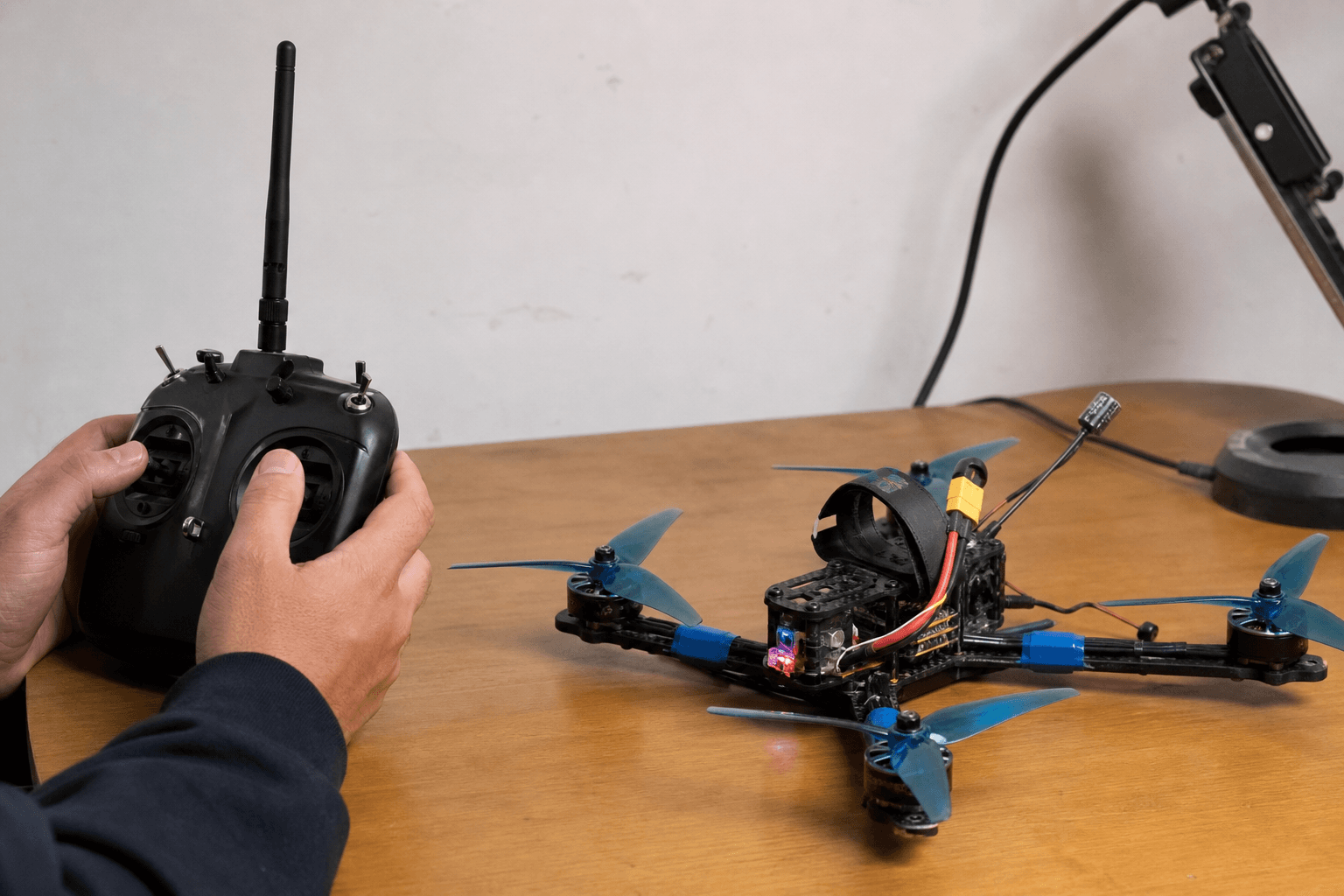
Receiver type does not change failsafe scenarios, FC still needs stages configured. EdgeTX model per quad still matters.
Put LQ on OSD: OSD essentials, regardless of UART or SPI.
India stocking
UART receivers are easy to stock multiples, buy a spare before a trip. SPI whoop FCs: confirm domestic shop stock on your exact AIO board, not "similar looking" board.
Order the right RX once; fly more, forum less.
ELRS receiver sizing
| Frame | Typical RX |
|---|---|
| 5" | EP-style UART |
| 3" | EP1 UART or compact SPI on AIO |
| Whoop | SPI on AIO most common |
Antenna length matters on 900 MHz, cramming a long stub under a whoop duct kills performance regardless of UART vs SPI.
Aftermarket FC swap
Moving from whoop AIO to 5-inch separate FC almost always means UART RX: budget new RX, do not assume desolder SPI express from dead whoop board is worth the hour.
Betaflight receiver tab sanity
On first arm after install, open Betaflight receiver tab with props off. Sticks should move cleanly 1000–2000 on relevant channels; aux switches should toggle without chatter. Chatter often means loose pad or wrong inversion, fix before first flights after new build.
Crossfire note
CRSF receivers are almost always UART on 5-inch builds. SPI express is ELRS-whoop territory in practice, do not order SPI when your FC manual shows only UART pads and you run Crossfire from legacy gear.
UART resource planning on one FC
UART pads are finite. GPS, vtx control, RX, and accessories compete. Plan before solder:
| UART user | Typical need |
|---|---|
| ELRS / CRSF RX | One UART, often UART6 on many F7 boards |
| GPS | Dedicated UART, baud matters |
| VTX SmartAudio / Tramp | One UART shared or softserial, check FC docs |
| ESC telemetry | Sometimes same UART as RX, conflict |
Screenshot your Betaflight ports tab after a working config. Spring maintenance without photos costs an evening.
Antenna routing by RX type
UART RX on 5-inch often mounts on an arm or standoff away from vtx heat. SPI whoop RX sits under the canopy, carbon shadow and vtx proximity are tighter. Route pigtails so crash impacts do not yank pads; hot glue strain relief is ugly and effective.
900 MHz stubs need clearance, folding antenna under duct kills range regardless of bind success. See 2.4 vs 900 urban when picking link for your city.
Spare RX stocking
UART EP receivers fit in a small parts box, keep one programmed with your bind phrase before a trip. SPI whoop FC failure often means whole-board swap; stock the exact AIO model your fleet flies, not a visually similar board with different target name.
Discussion
Comments aren't open on this post yet. Share it with your build group, or start a thread on X.