

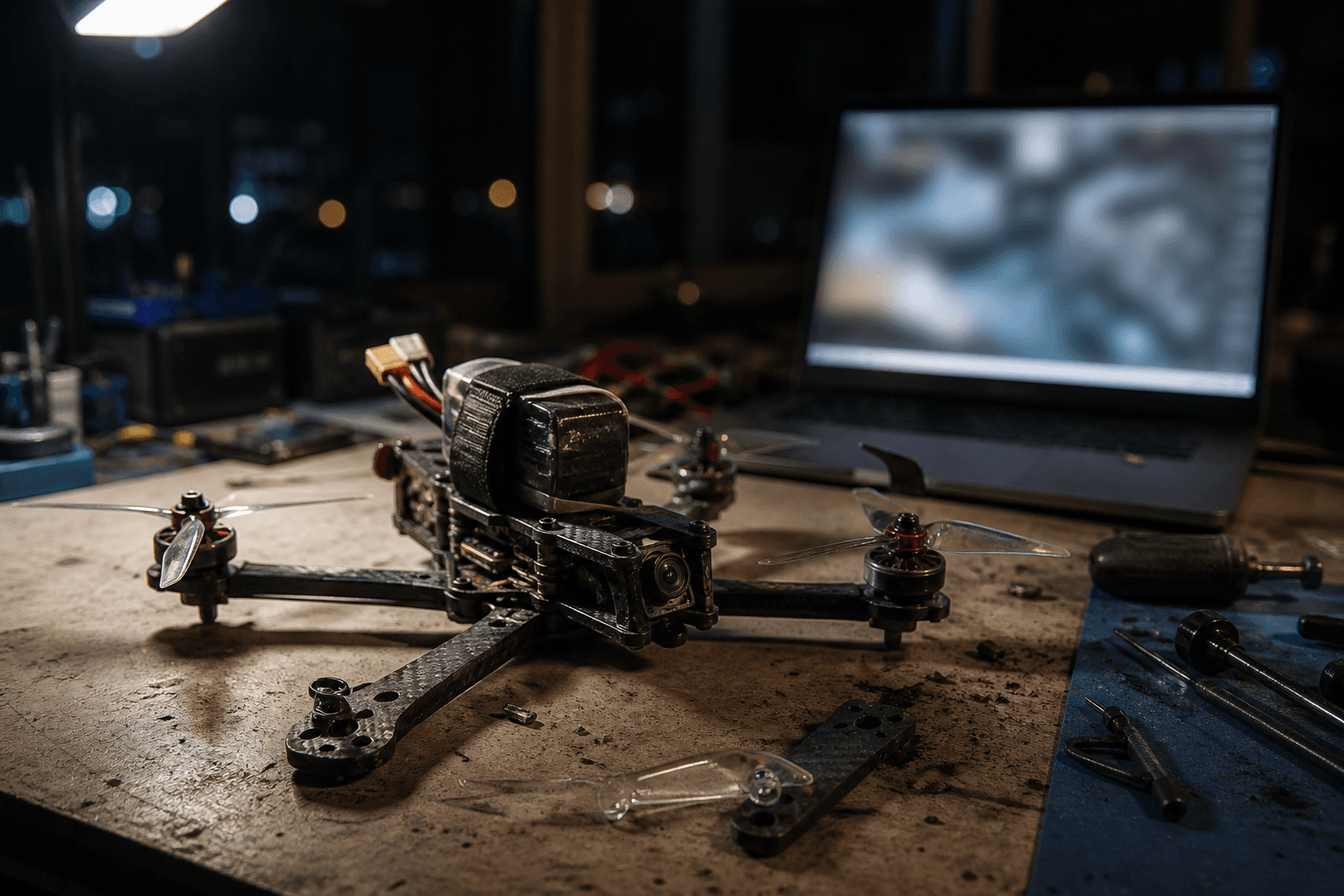
Tuning after a crash

A hard hit changes mechanics first; settings almost never change on their own. Tuning over a bent motor is how pilots burn afternoons, cook ESCs and convince themselves Betaflight "broke." The quad doesn't know it crashed; it only reads gyro noise and stick input. If the noise jumped because a bell is wobbling, every PID slider move is theatre until the physical problem is fixed.
When NOT to tune after a crash
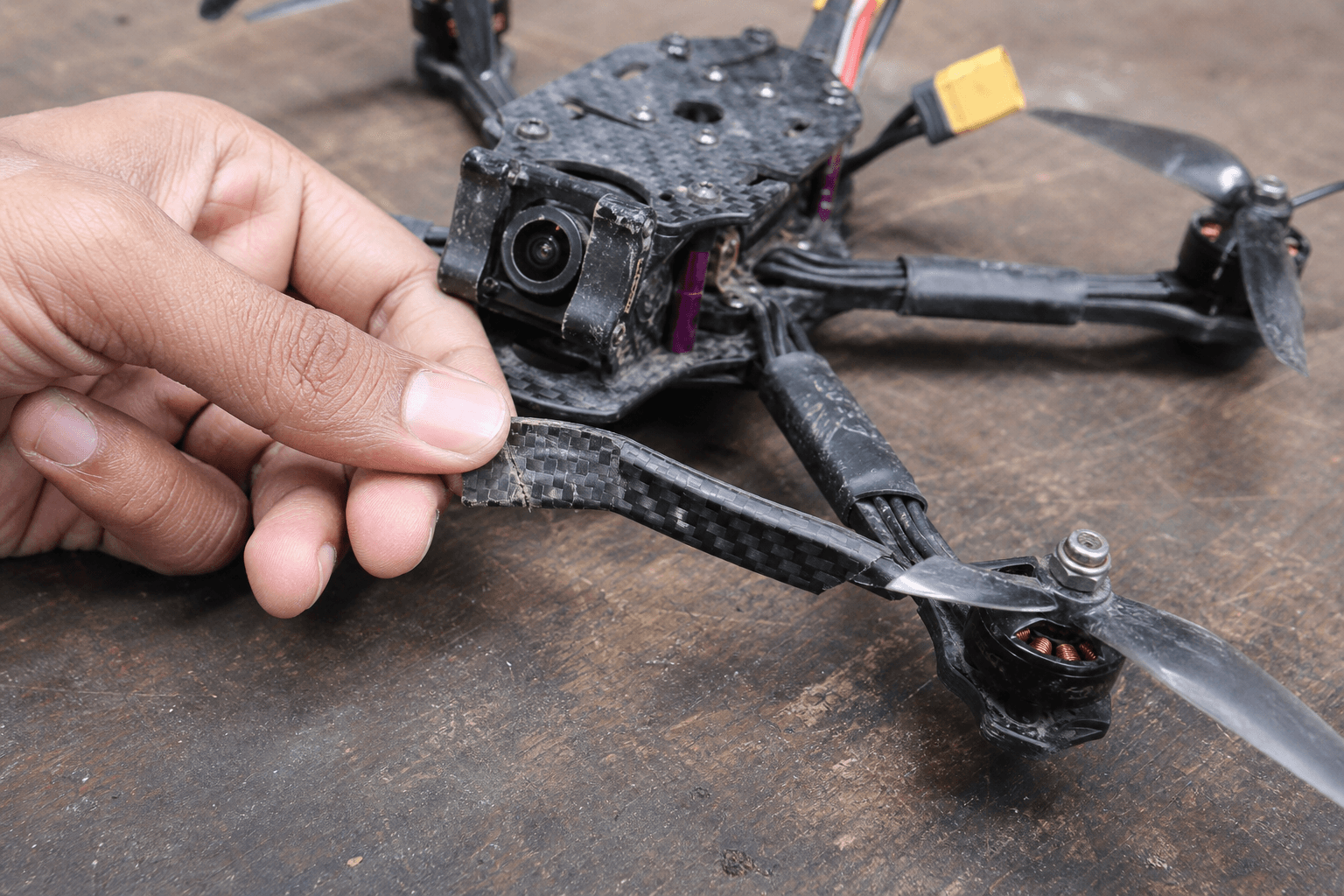
| Situation | Do this instead |
|---|---|
| Visible prop chip or bend | New props, always |
| Motor grit when spun by hand | Bench or replace motor |
| Frame crack at arm root | Repair or replace arm, carbon stress |
| Loose camera / VTX mount | Tighten it; jello isn't a PID problem |
| "It flies okay" but sounds different | Inspect; "okay" is subjective |
If inspection fails, don't arm for a tune session. Do crash repair triage first.
Inspect before sliders
A structured five-minute pass saves an hour:
- Props: replace, don't straighten; compare blades by eye
- Motor bell: spin by hand; grinding, clicking or wobble = bench the motor
- Motor base: screws tight; the bell shouldn't move up and down on the shaft
- Frame: cracks at arm roots, loose standoffs, twisted plates
- Stack: FC still level; soft mounts not torn
- Arms: not visibly bent
- Camera / VTX: mounts snug; antenna not cracked at the connector
- Battery: no puffing, connector strain or torn wrap
Whoops: the same checklist, smaller. A slightly bent 1.0 mm shaft is common after a hard hit, and on a whoop the fix is a new motor, not straightening. Also check the ducts for cracks and the props for a loose fit on the shaft.
See crash repair triage for field vs bench depth.
Smoke test: after a motor swap or stack work, use a smoke stopper, not a full punch on the first arm.
Bent shaft tell
| Sign | Meaning |
|---|---|
| Gritty sound at low throttle | Bearing or shaft damage |
| Excessive heat vs other motors | Friction or imbalance |
| Visible bell gap or wobble | Shaft bent or bell loose |
| Vibration only that corner | Isolate motor before PID |
| Prop track wobbles when spun | Shaft or prop seat |
Don't "fix" it with D. Replace the shaft (on motors that allow it) or the motor. Prop balancing doesn't fix bent steel.
Bench motor test (props off): spin each motor from the Motors tab. Swap a suspect motor to another ESC output: if the problem follows the motor, it's the motor; if it stays on the channel, it's the ESC or a solder joint. Five minutes beats PID roulette.
Symptom → action after crash
| Symptom on first hover | Likely cause | Tune? |
|---|---|---|
| Immediate oscillation | Prop, motor, or loose mount | Fix hardware first |
| Buzz only mid-throttle | Bent shaft or ESC damage | Bench |
| Slow drift or wobble | Frame twist or camera mount | Mechanical |
| Drifts in angle mode only | FC knocked out of level | Re-level, then recalibrate the accelerometer |
| Fine hover, bad only in turns | Slightly different props | Light filter check |
| Desync on punch | ESC damage or a cracked wire | Inspect the electrics |
Log in Blackbox only after the mechanical pass; otherwise you're tuning noise.
When to re-tune lightly
Small changes, same airframe identity:
- Same hardware, new props of similar load (same size and pitch)
- A minor arm replacement with the stack untouched
- Vibration slightly worse: check filters before PIDs
- Camera angle changed slightly: maybe a rates tweak, not a PID change
Workflow:
1. New props, tight bolts
2. Hover 1 pack, no aggressive tricks
3. If 90% same feel → fly session, note only
4. If buzz or heat → filters first, small steps
5. Log one manoeuvre if still off
When to reset or retune hard
Major changes, treat as partial new build:
- New motor or ESC channel
- FC replacement
- Stack remounted with different soft mount, soft vs rigid
- Mystery oscillation after multiple prop swaps
- Frame plate or core replaced, resonance changed
- Significant weight change (new VTX, GoPro mount)
Load a known baseline tune for your frame class (a Betaflight preset or your saved diff), fly one pack, then use Blackbox if it's still off. Follow the order in Betaflight tuning basics: mechanical → filters → P → I → D → FF.
Save your tune: keep a CLI diff all from before crash day so you can compare against it.
Props and load changes
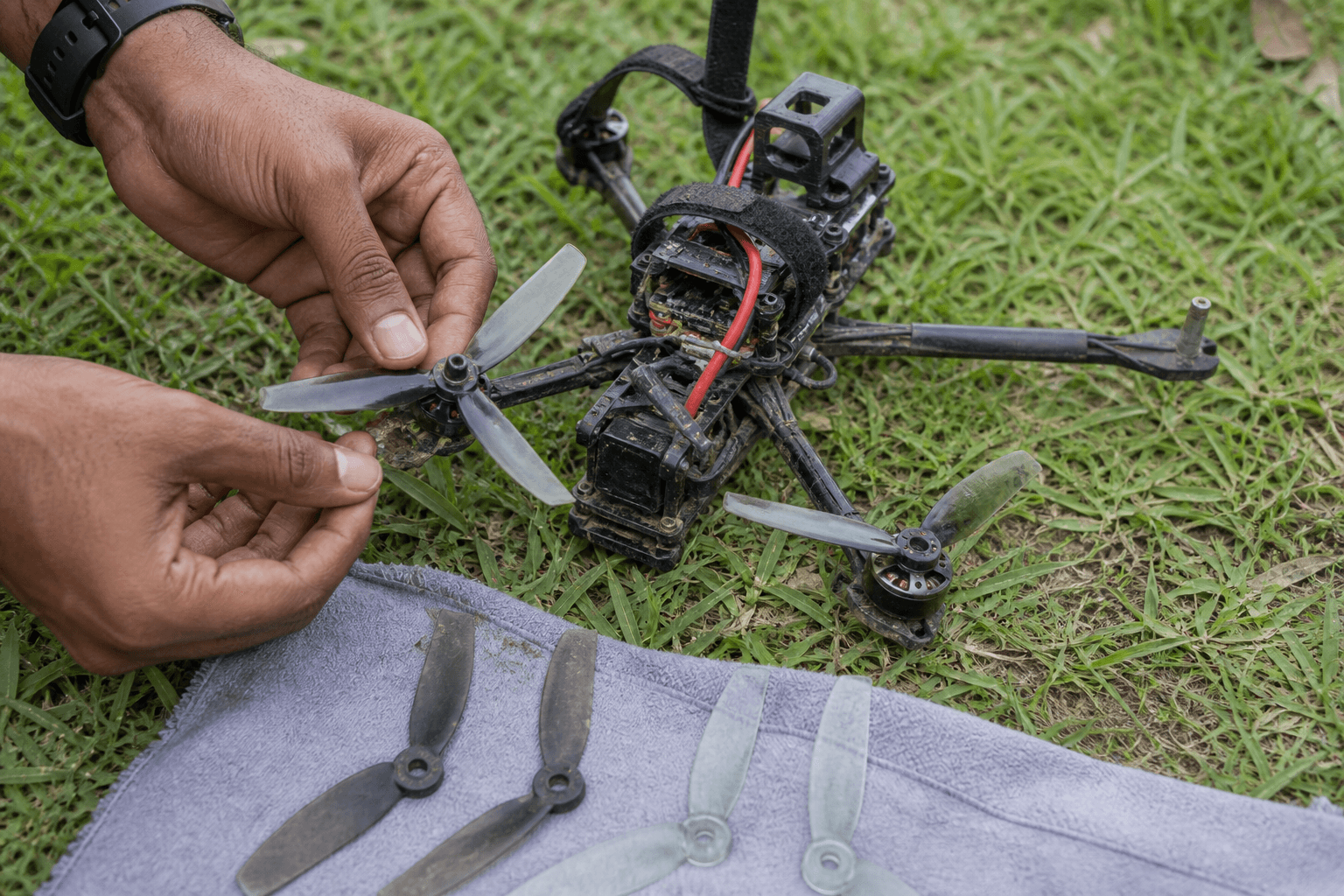
Switching to a different prop changes amp draw and noise. It doesn't always mean re-tuning everything, but expect to revisit filters if:
- Pitch jumped a lot
- You went from tri-blade to quad-blade
- The new props are noticeably heavier
See motor KV and headroom if new props pin throttle.
ESC and electrical after impact
A crash can crack components or loosen battery pads. If one motor desyncs:
- Inspect that ESC channel's solder joints
- Swap the motor to another output to isolate it
- Look at ESC firmware only after ruling out hardware
Don't lean on the RPM filter to mask a damaged ESC channel.
Rates and feel after a crash
Sometimes the PIDs are fine but feel changed after the camera or radio took a knock. Check camera angle, gimbals and rates and expo before resetting PIDs, especially if there's no oscillation.
India field note
Hard landings on concrete and dust are common, and bearings fail faster when grit gets into the bell. Carry spare props in your field kit, plus a spare motor if you fly remote spots.
Crashing onto hot asphalt in summer heat-soaks motors before the next arm. Let them cool before tuning or you'll chase heat noise.
Common mistakes
- Straightening props with pliers
- Adding D on a bent motor until the ESC smokes
- A full PID reset without fixing a known crack
- Skipping the smoke stopper after the stack took a knock
- Tuning in front of spectators instead of inspecting
When to stop and bench
If two prop swaps and a bolt check don't fix the oscillation, stop flying that quad. Bench test the motors one by one, check the gyro in Configurator with props off, and swap in a known-good motor.
Flying before a structural fix risks a tumbling crash that damages the LiPo. Not worth the clip.
| After crash | Tune action |
|---|---|
| Cartwheel, nothing bent | Fly; maybe a note |
| New props, same type | Light; filters if it buzzes |
| New motor or remounted stack | Reload baseline |
| Arm/plate replaced | Treat as a partial new build |
Slightly bent shafts often pass a visual check but vibrate under load, so trust the hand-spin and how the hover feels over optimism.
After a crash, the question isn't "what PID?" but "what broke?" Fix that, hover gently, then tune only what the logs prove. Your pre-crash tune is the goal; random slider changes are the detour.
Discussion
Comments aren't open on this post yet. Share it with your build group, or start a thread on X.