

Reading Blackbox without drowning

Blackbox is a mirror, not a magic wand. It shows what the flight controller thought happened, not whether your prop was bent. Start with three traces and one question: is this mechanical or software? Most pilots drown because they open a full-session log, zoom to 100%, and try to fix twelve problems at once. One maneuver, one change, one comparison.
When NOT to log (or not to trust logs)
| Situation | Why logs mislead |
|---|---|
| Bent prop, loose motor | Gyro noise dominates, filters and PID look "wrong" |
| Motors heat-soaked | Noise floor up; afternoon log ≠ morning tune |
| Mixed changes last session | You cannot attribute anything |
| Logging rate too low for props | Peaks smeared, you guess wrong |
| First pack on fresh build | Voltage highest; tune always feels best |
Fix props, tighten stack, cool motors. Logging a bent quad just prints noise you will try to fix with D-term, and then you will buy motors.
Setup: logging that helps
Before analysis:
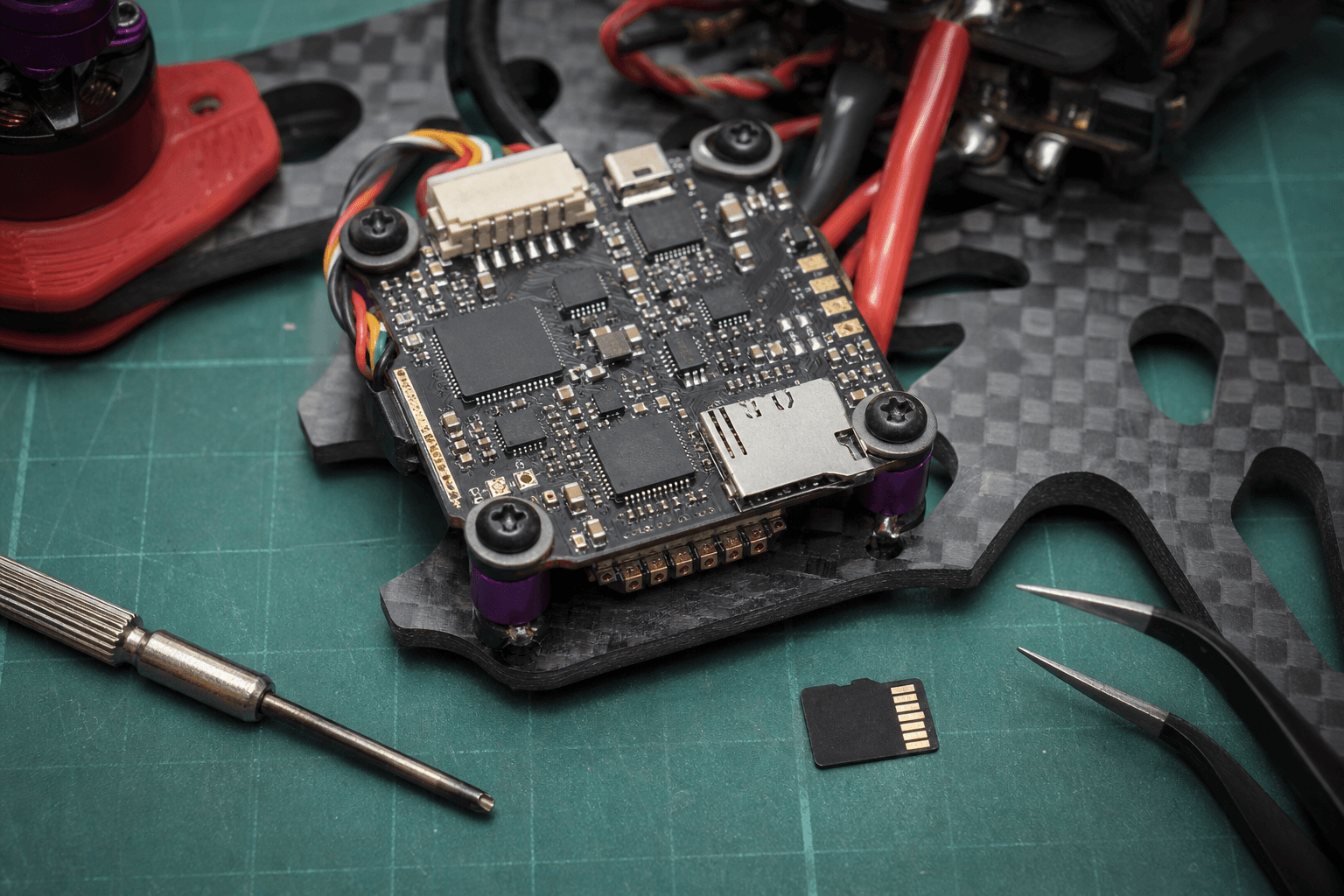
- Logging rate: 2K minimum for most 5"; 4K if you chase fine propwash and have SD space
- Debug modes: start minimal: gyro, PID, setpoint; add FFT later when basics make sense
- One bad move per log: fly deliberately: one hard corner, one flip, one punch-out
- Note metadata: prop type, pack number, ambient temp; future you will forget
Betaflight Blackbox Explorer, Plotsplosion, or your preferred viewer, same ideas. The tool matters less than discipline.
Trace 1: Gyro (filtered vs raw)
Gyro is ground truth for what the FC sensed. Compare raw vs filtered gyro on roll or pitch.
| Pattern | Likely meaning | Next step |
|---|---|---|
| Spiky raw, smooth filtered | Filters working hard | Check if stick feel is mushy, may be over-filtered |
| Spikes on throttle punches | Often prop/motor/mechanical | Inspect props, bearings, bell play |
| Constant fuzz all throttle | ESC noise, loose mount, bad bearing | Mechanical; see tuning after a crash |
| Spikes only one axis | Frame resonance or loose camera | Check that arm, mount, standoff |
| Raw and filtered both wild | Severe mechanical or desync | Land; bench test motors |
Common mistake: cranking D because the gyro line looks "busy" without checking whether the quad felt bad in that moment. Correlate with stick input and throttle.
Trace 2: Setpoint vs actual (roll/pitch)
Setpoint is where the PID wants to be; gyro (or PID sum) shows response. This is the core tracking view.
| Pattern | Likely meaning | Knob direction |
|---|---|---|
| Actual lags setpoint on snaps | P low, FF low, or over-filtered | Small P or FF bump; check filters |
| Actual overshoots then settles | P high or D low | Reduce P slightly or add D carefully |
| Oscillation on settle | P/D balance or mechanical | Do not only add D, check buzz source |
| Tracking good in hover, bad in turns | Propwash / throttle region | See propwash tuning |
| Slow wobble (1–3 Hz) | I windup or P too high on heavy quad | I down or P down, context matters |
Zoom to one flip or one 180: not the whole pack. Align setpoint step with the moment you felt washout.
Trace 3: Throttle
Throttle correlates problems to power regions:
- Punch-outs: prop/motor load, ESC noise, filter stress
- Mid-throttle cruise: resonance, bearing issues, ESC timing
- Decaying throttle in turns: classic propwash zone
Draw a mental line: if ugly traces only appear when throttle drops in a hard turn, you are in propwash territory, not always "more P everywhere."
Motor RPM trace (with bidir DShot) helps confirm ESC telemetry is sane, erratic RPM alongside gyro fuzz means fix telemetry before RPM filter tuning. See RPM filter and bi-directional DShot.
Trace 4: PID sum and motors (when ready)
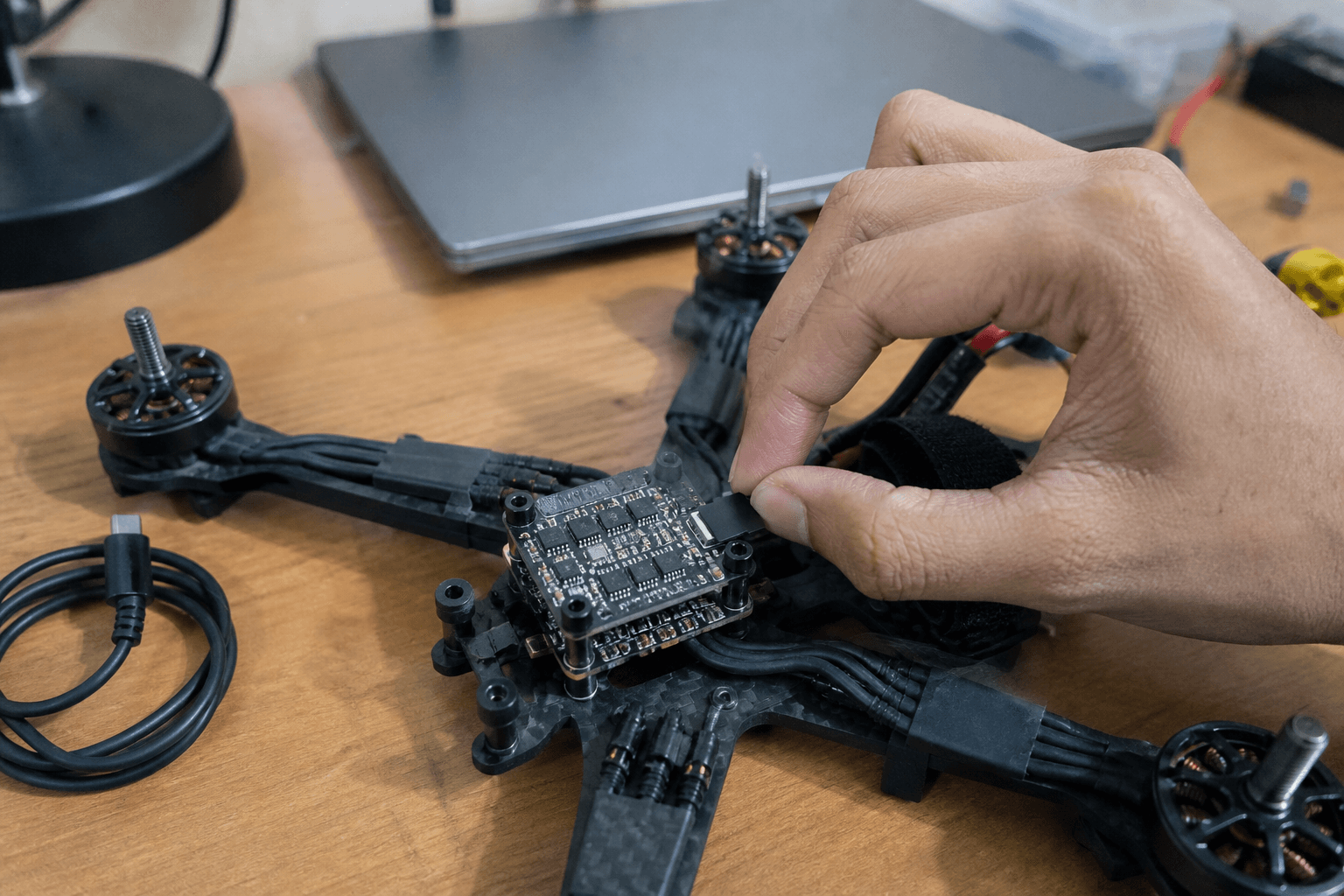
When basics are clear, look at PID sum and per-motor outputs:
- Motor saturation: one motor pinned while others are not → mechanical twist, bad mix, or damaged motor
- Oscillation in PID sum: tune issue if mechanicals clean
- Asymmetric motors: crash damage, reversed motor, or ESC channel fault
Do not start here on day one, gyro + setpoint + throttle solve most field questions.
Learn traces in order: gyro → setpoint vs gyro → throttle → PID sum last. Note prop type, pack number, and maneuver name in a phone note, future you will not remember "the weird split-S" file.
Workflow
1. One bad maneuver per log, do not fix everything at once
2. Compare before/after ONE change (save profiles!)
3. Land when motors hot, logs lie when hardware is tired
4. Ask: did this trace look bad when I felt bad?
5. If no → look at rates, vtx, or pilot input; if yes → one knob
A/B comparison tips:
- Same battery class and similar voltage
- Same maneuver name, "left hand power loop" not "sort of a loop"
- Overlay logs in Explorer if your tool supports it
- Write the change on paper: "FF roll +5" not "tweaked stuff"
Symptom → trace → action map
| In the air you feel | Look at | Often fix |
|---|---|---|
| Sloppy snaps | Setpoint vs gyro on roll | FF, P, or filter reduction |
| Buzz after flip | Gyro settle region | D + filter, not more P |
| Nose drop in dive | Throttle + pitch tracking | Mix habit, I, or tune, also camera angle |
| Mid-throttle hum | Gyro raw at cruise throttle | Mechanical, ESC timing, RPM filter |
| Gets worse each pack | Compare pack 1 vs pack 4 logs | Heat, hot climate filters |
Common mistakes
- Analyzing a 6-minute log without zooming to events
- Changing PID because gyro looks noisy when feel is fine
- Ignoring throttle column, propwash is throttle-dependent
- No baseline log before changes
- Trusting logs from a quad with a known bent prop "just to see"
When to stop staring at logs
If traces look mediocre but the quad feels great in goggles, stop tuning. Good enough beats perfect on a Sunday field.
If traces look fine but feel is bad, check rates, camera angle, vtx antenna, and radio link before another PID pass.
If traces and feel are both bad and mechanicals are verified, follow Betaflight tuning basics order: filters → P → I → D → FF.
Mechanical check before PID: noise on one motor channel = inspect corner; spikes at same throttle = prop/ESC; ugly only when stick moves = more likely tune. Swap props, re-log, then open configurator.
Blackbox rewards patience. One trace, one question, one change, then fly again. Your logs should get shorter over time because the quad stops misbehaving, not because you stopped looking.
Discussion
Comments aren't open on this post yet. Share it with your build group, or start a thread on X.