

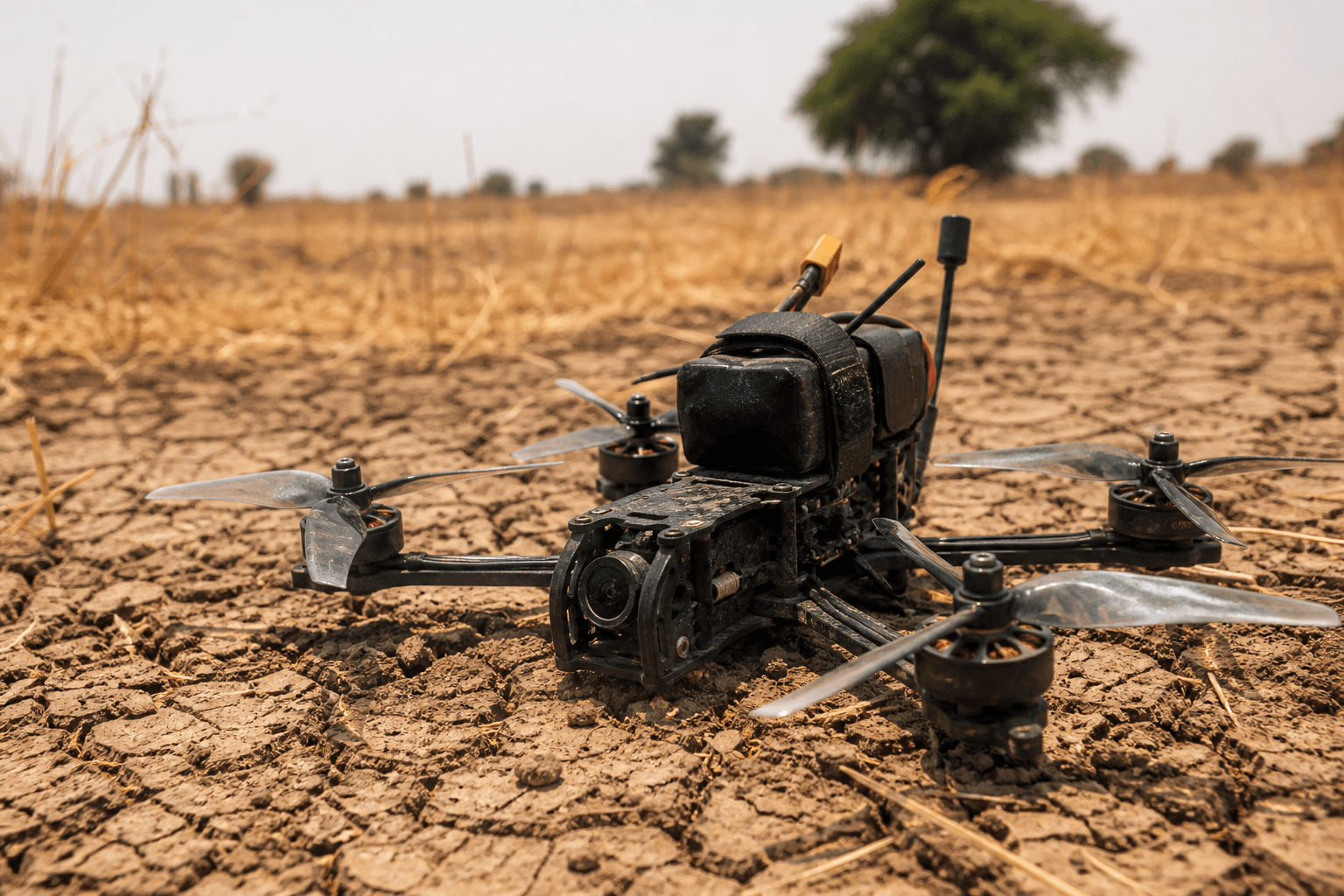
Filter tuning for hot climates, India summer and motor heat

Forum tunes built on 20 °C fields don't always survive 40 °C days, with sun on black carbon and motors that never fully cool between packs. Hot-climate tuning isn't magic. It means accepting that thermal headroom and gyro noise move together, and that D-term is not a universal fix.
When NOT to filter-tune
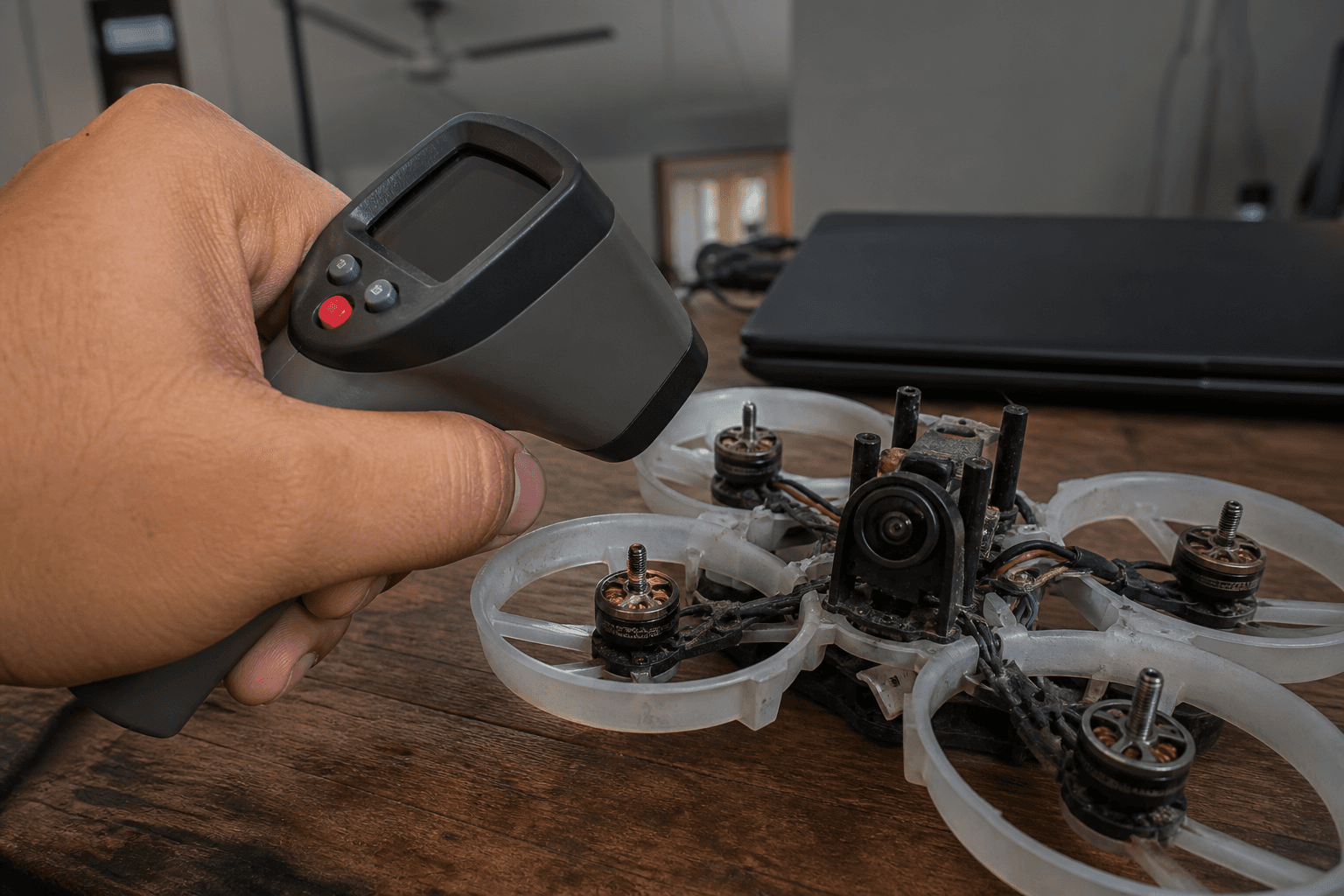
More filtering is not always the answer. Stop and fix hardware or session habits if:
| Situation | Real fix |
|---|---|
| Motors scorching after 30 seconds | Prop load, ESC size or a bent shaft, not another notch |
| Noise only on one motor | Phase wire, bullet or bearing; see tuning after a crash |
| Quad fine on pack 1, bad by pack 4 | Heat soak: rest longer between packs, shade your gear |
| Mushy all day even with filters off | Over-filtered elsewhere or mechanical slop |
| Desyncs when enabling RPM filter | ESC protocol or firmware; see RPM filter |
If the quad flew well in March and feels wrong in May, suspect heat and battery sag before you rebuild your entire filter stack.
What heat actually changes
As motors and ESCs warm through a session:
- Copper winding resistance rises with temperature, so motors waste a little more power as heat and throttle feel can creep.
- Bearing friction and grease behaviour change; small per motor, but real over a long freestyle afternoon.
- Gyro noise from vibration and electrical noise often rises as everything heats up and soft parts (grommets, TPU) get softer.
- LiPo packs actually sag a little less when warm, but heat speeds up ageing and puffing. A pack that comes down hot should cool before you charge or fly it again.
You can't firmware away an undersized ESC or a bent shaft, but you can stop D-term fighting a noisier gyro all afternoon. The hot-climate habit: filter first, D second, and know when to close the laptop.
Mechanical first (still)
Before filter sliders, run the same mechanical pass as any tune day:
- Props: chipped edges and hub cracks show up as heat and buzz. Replace them; don't fly "one more pack".
- Motor screws: loose motors get louder as they warm, and more vibration reaches the gyro.
- Stack mounting: hardened or crushed grommets pass more vibration. See stack soft mount vs rigid.
- Wire routing: motor wires rubbing carbon or pinched on arms get worse as insulation softens in the sun.
If the mechanicals are clean and motors are still too hot to hold after normal freestyle (not endless punch-outs), check KV and prop load: the motors may be undersized for your style. See motor KV and throttle headroom.
Reading the noise floor
Hot-day noise often shows up as:
- Fine oscillation at hover and mid-throttle where morning tune was calm
- D-term hiss that grows through the pack
- Blackbox gyro trace with more high-frequency fuzz after pack 3
Log the hottest pack of the day, not the first cool hover. Compare it with a morning log on the same tune: if only the afternoon log is ugly, you're fighting heat, not a bad baseline.
Filter bias for hot days
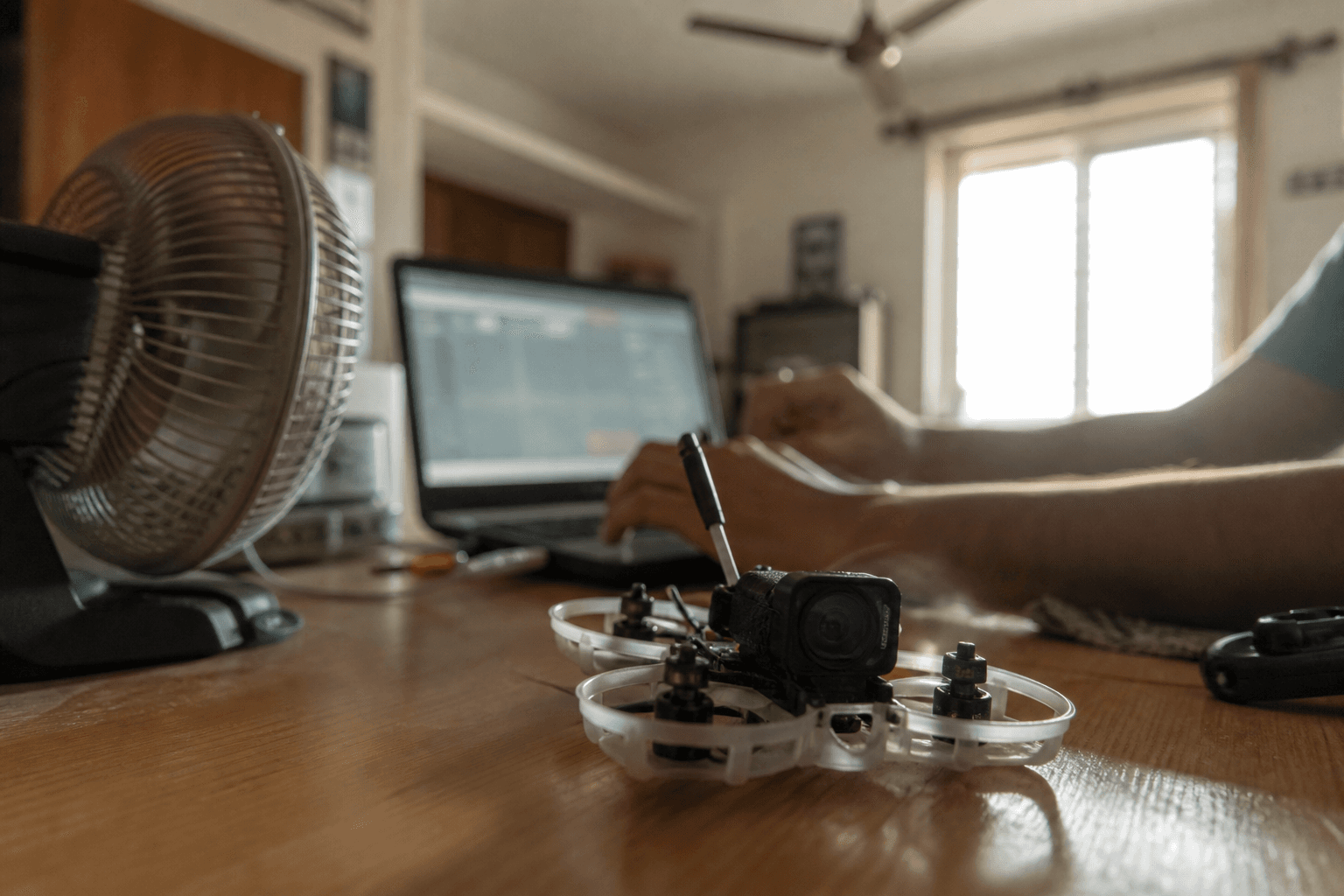
General direction, not a preset (your ESC, props and mounting all matter):
| Symptom | Hot-climate lean |
|---|---|
| Motor heat + fine oscillation | Slightly more filtering before cranking D |
| Mushy, delayed response | You may have over-filtered: back off one step, not three |
| D-term hiss on punch-outs | Reduce D or add filtering; don't do both blindly |
| Same tune morning vs evening | Expect drift: land, cool, re-check |
| Good cruise, bad in hard turns | Propwash plus heat; see propwash tuning |
RPM filtering with bidirectional DShot helps when your ESCs support it: it removes motor noise that D-term would otherwise amplify. Test it with a short hover before a full freestyle session in the heat. A wrong motor pole count puts the filter on the wrong frequency and makes things worse, not better.
Filter workflow (hot session)
1. Morning: confirm baseline hover and one hard line, log it
2. Mid-session: if buzz appears, land and feel motor temps
3. One filter change OR one D change, never two big ones
4. Re-fly the same line on a similar pack
5. Still hot and buzzy with conservative filters? Lighter props, not more D
Common mistake: copying someone's summer tune built for different motors and ESCs. Filters interact with gyro loop rate and ESC protocol.
When summer and winter tunes clearly differ, save a CLI diff of each. Restoring a known file beats rebuilding filters from memory when a March tune cooks motors in May.
D-term in heat
D amplifies gyro noise. When the noise floor rises with temperature, the same D that felt crisp at 25 °C turns into motor heat at 40 °C. Hot-climate pilots often run slightly lower D with slightly more filtering than temperate recipes, trading a little snap for motors you can touch.
If you must choose, cooler motors beat slightly better propwash handling. Nobody wins a summer meet by replacing ESCs in the parking lot.
Session discipline
Field habits matter as much as sliders:
- Shade the quad and battery bag between packs; hot ground radiates heat back into the frame.
- Don't charge hot LiPos in a closed car; see LiPo safety.
- Rotate packs: three packs cycling beats one pack hammered until it puffs.
See summer heat field day packing for the full kit mindset.
When to stop tuning
If motors are too hot to touch after normal freestyle and filters are already conservative, the fix is usually:
- Lighter props (lower pitch, or smaller diameter within frame limits)
- More throttle headroom: you shouldn't live at 98% throttle
- More ESC current margin on high-KV 6S builds
- Shorter runs between cool-downs, not another filter preset
Hot-climate tuning is maintenance: revisit it after prop changes or new ESC firmware.
Symptom → fix quick map
| You feel / see | Try first | Try second | Do not |
|---|---|---|---|
| Afternoon buzz only | Shade + cool-down | Slight filter increase | +20 D all axes |
| Mushy after filter bump | Revert one step | Check for over-filter in Blackbox | Keep stacking notches |
| One hot motor | Inspect that motor | Swap prop on that corner | Match D to "fix" it |
| Oscillation on arm | ESC protocol, caps | Reduce D, add filter | Ignore desync warnings |
Filters set the ceiling for how much D and P you can run before motors overheat. In an Indian summer, respect that ceiling: the quad flies longer and your field repair kit stays in the bag.
See also
- Betaflight tuning basics: order of operations before climate-specific tweaks
- LiPo safety: charging, storage, and field habits: summer heat and monsoon storage
- Motor KV, prop size, and throttle headroom: current margin when the air works against you
Discussion
Comments aren't open on this post yet. Share it with your build group, or start a thread on X.