

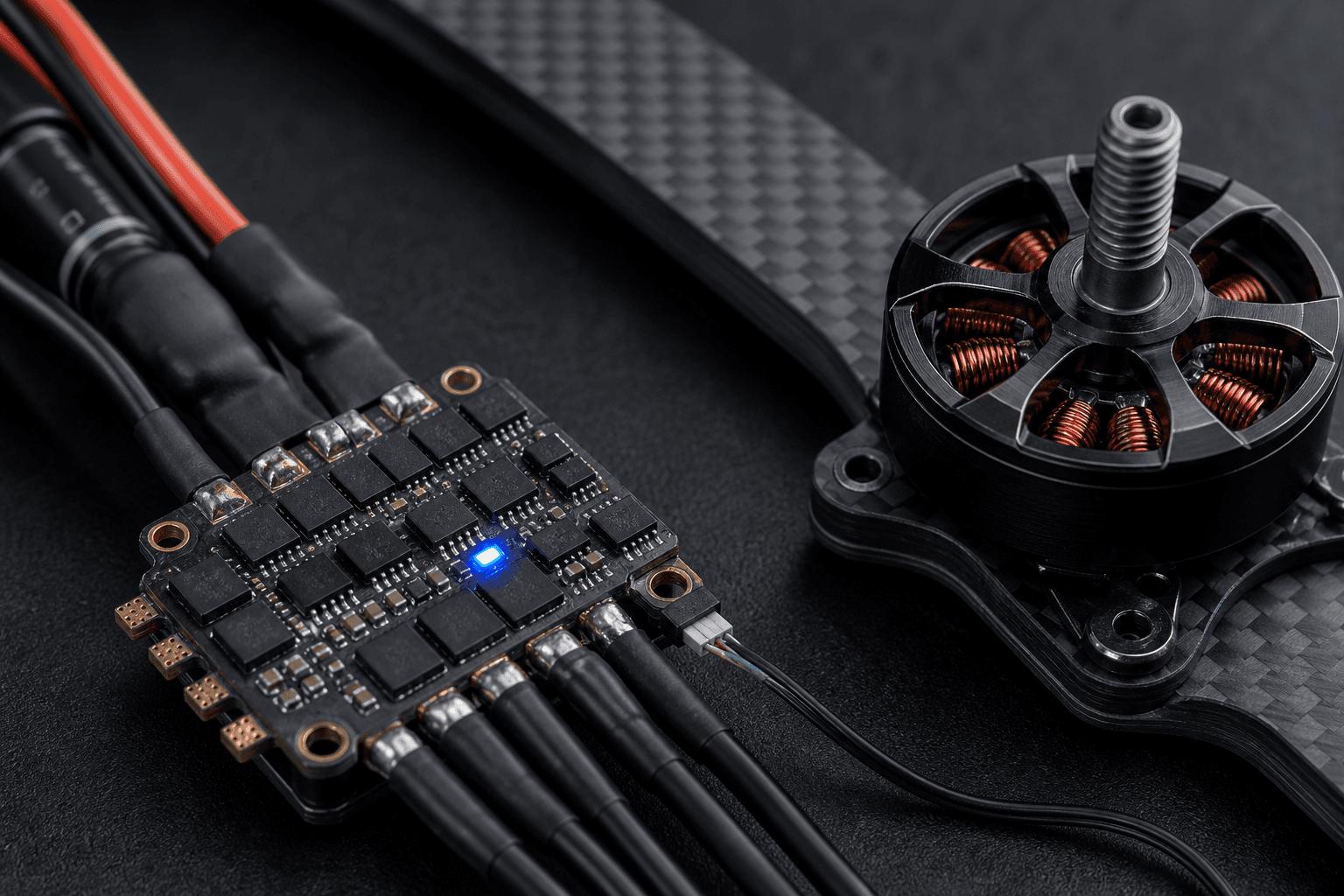
RPM filter and bi-directional DShot

Bidirectional DShot lets the ESC send motor speed (eRPM) back to the flight controller on the same signal wire. With newer ESC firmware and Betaflight's extended telemetry, it can also send temperature, voltage and current. The RPM filter uses that speed data to place notch filters exactly on each motor's noise before the PID loop sees it. Together they're one of the biggest upgrades on any modern quad, from 5" to whoops, when set up correctly. Set up wrong, they bring desyncs, misplaced notches and afternoons spent blaming Betaflight.
What problem this solves
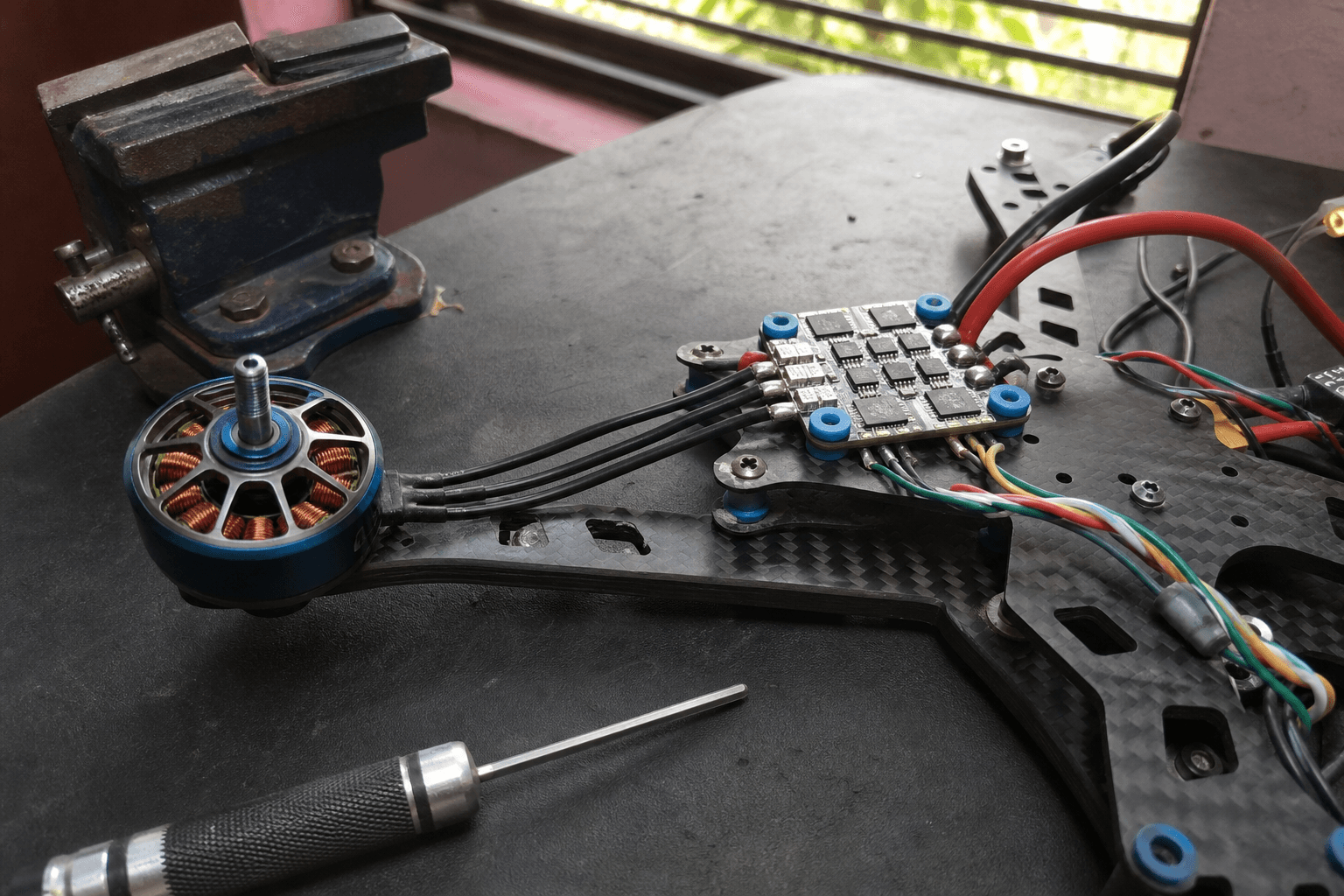
Motor noise isn't one frequency; it moves with throttle and RPM. Static notches can't follow it across the throttle range. The RPM filter tracks each motor's speed and moves its notches to match, removing gyro noise that D-term would otherwise amplify. That usually lets you run lighter low-pass filtering, so the quad feels more connected.
It matters more in hot weather, when noise and heat build through a session; see filter tuning for hot climates.
Requirements
| Requirement | Why it matters |
|---|---|
| ESC firmware with bidir DShot | Bluejay (BLHeli_S hardware, common on whoop AIOs), AM32, or BLHeli_32 (no longer developed); see ESC firmware. Stock BLHeli_S has no bidir |
| A DShot protocol in Betaflight | DShot300 or DShot600 with bidirectional enabled (Motors tab) |
| Motor pole count correct in Betaflight | Wrong poles = notches on the wrong frequency |
| Clean motor wires and solder joints | Bad joints = noisy RPM data |
| Adequate capacitor on the ESC / stack | Electrical noise = telemetry errors |
Flash and verify ESC firmware before enabling bidir in Betaflight. Mixed firmware across one quad's ESCs is a troubleshooting trap.
Motor pole count: get it right
The RPM filter converts eRPM to real RPM using the pole count. If motor_poles is wrong, every notch sits off the real noise, the gyro stays dirty and D keeps fighting it.
Betaflight's default is 14, which suits most 5-inch motors (12N14P). Most whoop and micro motors (0802, 1102, 1103 and similar) are 9N12P, so set 12. Check yours:
| Source | How to verify |
|---|---|
| Motor product page | Configuration listed as e.g. 9N12P (the number before P is the pole count) |
| Count magnets on the bell | Each magnet is one pole |
| Guess from a forum | ❌ Last resort |
When you swap motor brands after a crash, re-check poles even if KV and size match.
When to enable
Good candidates:
- Almost any quad whose ESCs support it, once the mechanics are sound (props, bolts, mounts)
- Hot motors on an otherwise sane tune, where noise rather than amp load is the cause
- Clean gyro data for Blackbox work
- Builds where D felt necessary but caused heat; cleaner gyro may let you keep D with less heat
- Whoops: bidir also enables dynamic idle, which helps propwash and prop bite at low throttle
Skip or fix first:
- Random ESC desyncs on arm or punch: fix protocol, timing and caps first
- Mixed ESC firmware on one quad: match versions
- Motors with damaged bearings or bent shafts: telemetry can't fix mechanics
- Unknown pole count: check the motor specs
- ESCs with flaky telemetry: bench test before the field
One step at a time: if the quad flies well now, enable bidirectional DShot first, hover, log a pack, then check the RPM filter. One change per checkpoint.
Enable workflow
1. Flash / verify ESC firmware (all four ESCs on the same version)
2. Betaflight Motors tab: enable bidirectional DShot, set motor poles
3. Bench, props off: spin each motor from the Motors tab and
   check the RPM readout and error % (should be near 0)
4. Props on: hover 30 seconds, listen for desyncs, check motor temps
5. Blackbox: confirm the RPM trace follows throttle smoothly
6. Filters tab: check the RPM filter is on (it's on by default
   once telemetry works)
7. Log the same hover; compare unfiltered gyro before/after
8. Field: one normal pack before trusting it at a meet
Save a CLI diff before enabling bidir so you can revert quickly.
Failure signs
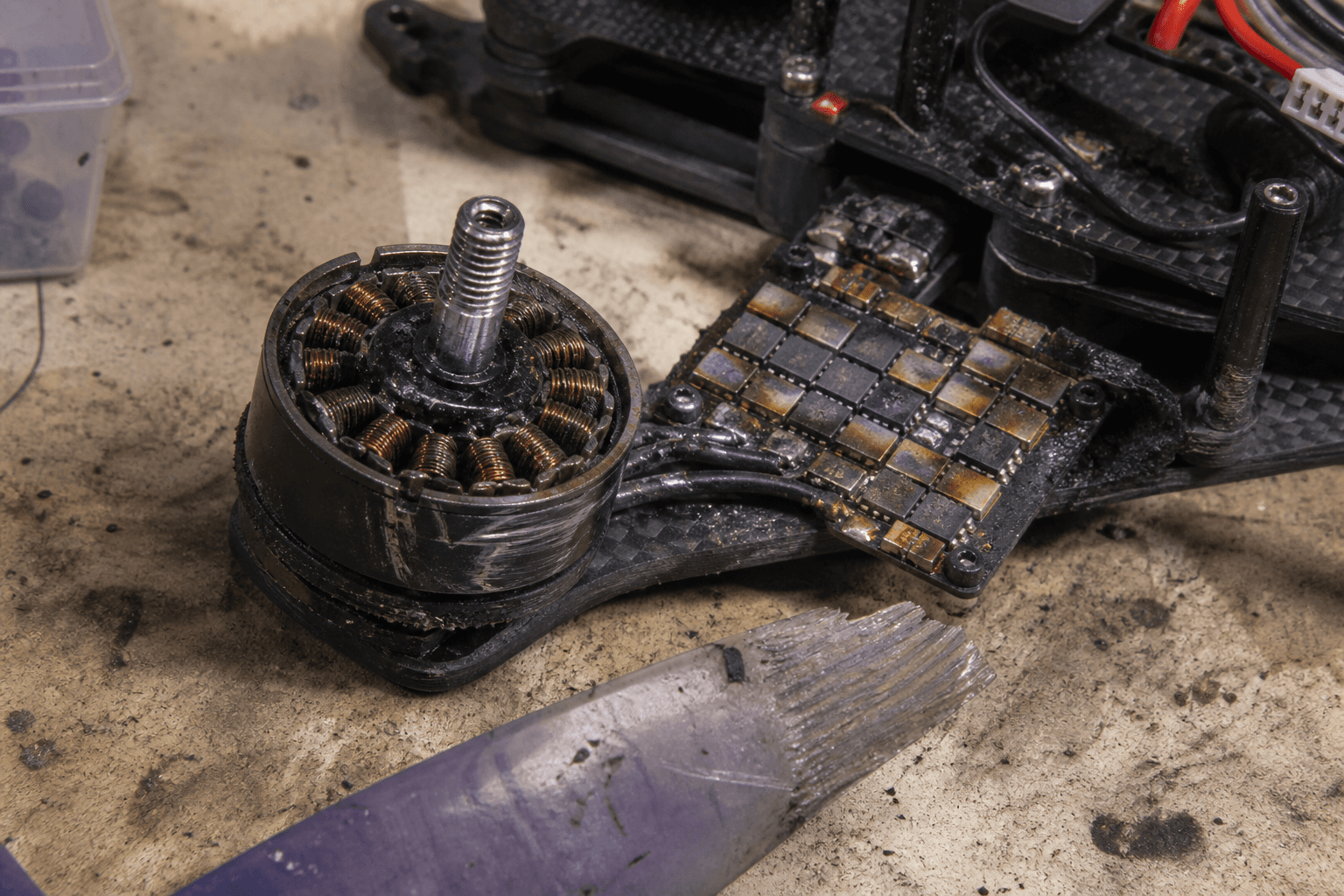
| Symptom | Check |
|---|---|
| Motors won't spin or arming blocked after enabling bidir | ESC firmware lacks bidir support (stock BLHeli_S); flash Bluejay or AM32 |
| Desync on arm | Bidir off temporarily; ESC protocol; capacitor; motor direction |
| Worse oscillation with RPM filter on | Motor pole count wrong; bad telemetry |
| One motor hotter than others | Phase wire, connector or ESC channel, not PIDs on one axis |
| RPM trace missing or jumping in logs | ESC doesn't support bidir properly; wiring fault; DShot rate too high for the board |
| Good hover, desync only on punch | ESC timing / demag settings; amp limit; weak battery |
| Telemetry works on 3 motors only | Swap motors to isolate ESC channel vs motor |
Change one thing at a time and log a pack between changes, the same discipline as the Blackbox workflow.
Tuning interaction
The RPM filter handles motor noise; you still need sensible low-pass and dynamic notch filtering for everything else (frame resonance, prop wash). Typical order:
- Mechanical sanity
- Bidir DShot verified, RPM filter on
- Then adjust the other filters per Betaflight tuning basics; with RPM on you can often run them lighter
- Re-evaluate D with the cleaner gyro
Common mistake: enabling the RPM filter on a mechanically noisy quad and adding D because it still buzzes. Fix props first.
Common mistake: loading a preset that assumes RPM filtering on a quad without bidir telemetry. Without telemetry the RPM filter does nothing, and the preset's light filtering leaves you under-filtered.
Bluejay, AM32 and BLHeli_32 (telemetry angle)
All three support bidir on suitable hardware. Bluejay is the free firmware for BLHeli_S ESCs, which most 1S and 2S whoop AIOs use. AM32 is open source and actively developed for 32-bit ESCs. BLHeli_32 still runs on many older 32-bit ESCs but is no longer developed. Telemetry quality depends on the ESC hardware and a clean flash. See the ESC firmware comparison for flashing tools and how to avoid bricking a board.
India note: a replacement ESC or AIO may arrive faster than you can debug a half-flashed board. If bidir fails after a careful setup, test against a known-good ESC channel before re-flashing in a rush.
Symptom → fix map
| You see | Likely cause | Action |
|---|---|---|
| Instant desync when enabling bidir | Protocol mismatch | Match DShot rate; reflash ESC |
| RPM filter on, motors run hot or rough | Wrong poles | Count magnets or read the motor specs |
| Intermittent desyncs | Caps, solder, battery sag | Power path; shorter battery leads |
| Tune worse only in turns | Propwash | Don't disable bidir; tune propwash separately |
| Worked until an ESC reflash | Settings reset | Reapply timing, demag and other ESC settings |
India field notes
Summer heat raises ESC and motor resistance, and marginal ESCs show more telemetry errors in afternoon sessions. If bidir worked in winter and flutters in May, check battery condition and connector wear (XT30, BT2.0) before blaming filters.
Log the hottest pack when validating the RPM filter. Cool morning hovers flatter it.
Before/after log comparison
When RPM filter works, you should see:
| Trace | Before RPM filter | After (healthy) |
|---|---|---|
| Gyro filtered | More high-freq fuzz at mid-throttle | Cleaner cruise band |
| D-term activity | Spiky on punch | Calmer without mushy feel |
| Motor heat | Hot with the D you "needed" | Cooler at the same aggressiveness |
| RPM trace | Missing | Tracks throttle smoothly |
If the gyro cleans up but desyncs appear, back off: that's a telemetry or timing issue, not a reason for more filtering. Compare logs at the same throttle points, not whole-pack averages.
Bidirectional DShot and the RPM filter multiply the benefits of a clean quad. They don't rescue bent props, wrong KV or mixed ESC firmware. Enable slowly, log once, fly twice, then enjoy cooler motors once D stops fighting motor noise.
Discussion
Comments aren't open on this post yet. Share it with your build group, or start a thread on X.