
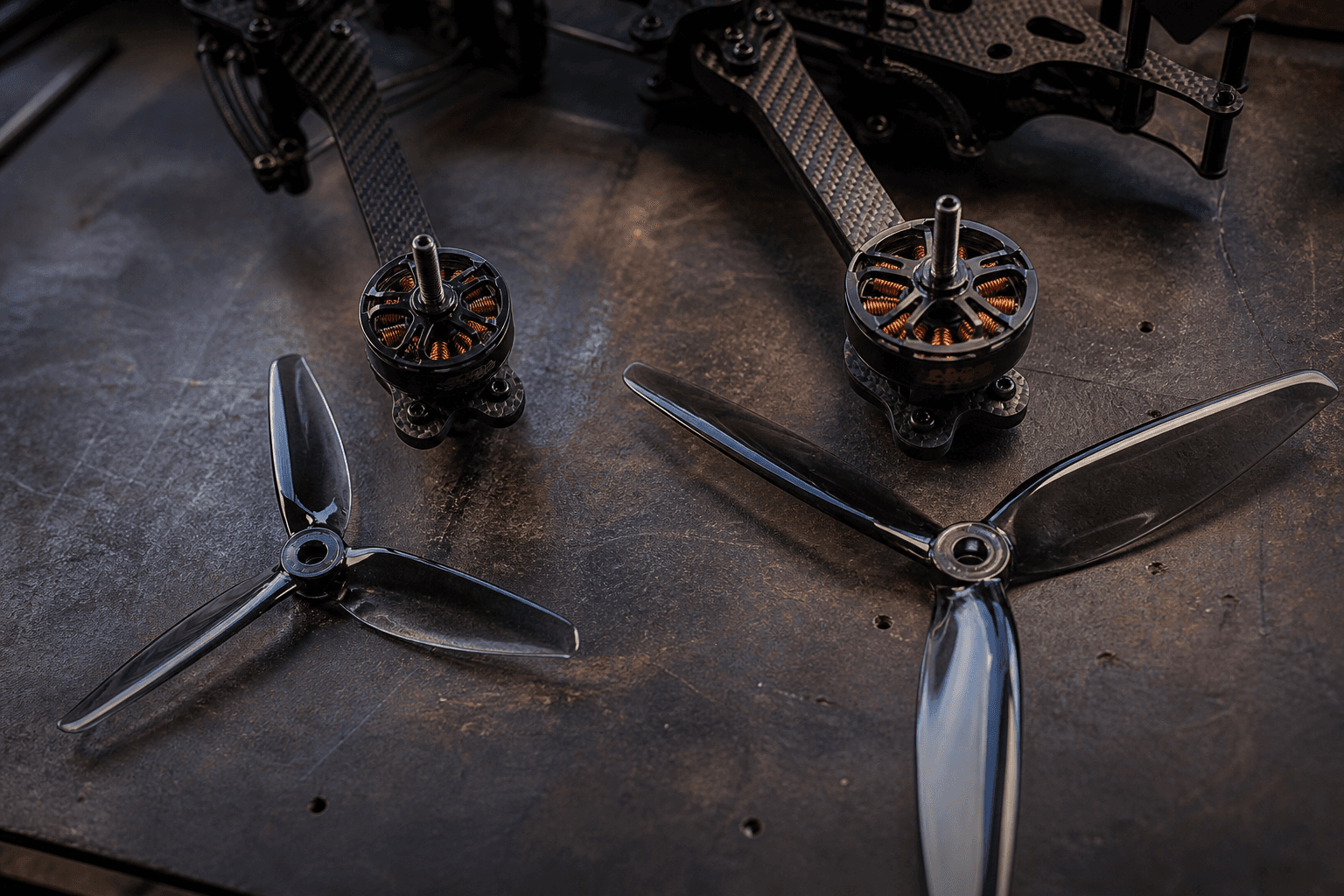
Motor KV, prop size, and throttle headroom, a build-math primer

Every “what motor should I buy?” thread boils down to three knobs: battery voltage (cell count), motor KV, and prop disc load (diameter + pitch + blade count). Twist them wrong and you either float a heavy quad on max throttle or roast ESCs on punch-outs. Build math is not calculus, it is consistent comparisons and logging.
Voltage and KV
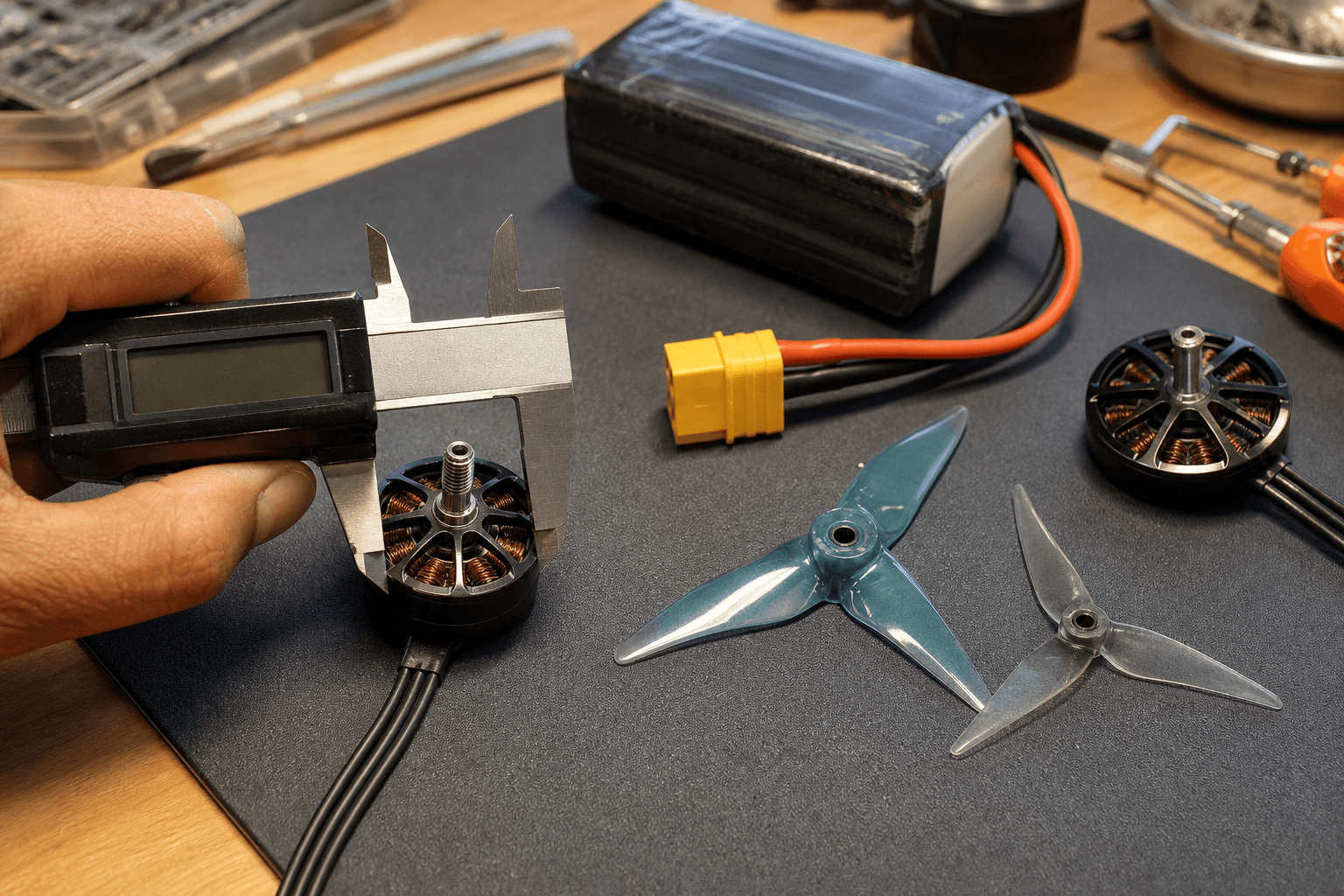
Higher KV spins faster at a given voltage, more theoretical rpm per volt. On 6S, a motor that felt perfect on 4S at “equivalent KV” can overshoot current unless you drop prop size or soft-mount your expectations.
Rule of thumb: when moving 4S → 6S, people often drop KV or prop load to keep similar blade speed and amp draw. There is no universal table because frame weight and ESC quality matter.
KV in plain language
KV rating tells you nominal rpm per volt applied, not a speed guarantee. Real rpm drops under load. A high-KV motor on aggressive props pulls more amps to maintain speed against disc drag.
| Move | Typical adjustment |
|---|---|
| 4S → 6S | Lower KV or smaller/lighter props |
| Heavier HD build | Lower prop pitch or larger stator |
| Hot climate flying | Favor efficiency over peak thrust |
Stator size matters too
2207, 2306, 2806, larger numbers generally mean more torque and mass. A 2207 on 5-inch freestyle is common; 7-inch long-range often uses larger stators at lower KV. Do not pick KV without stator class, see 7-inch explorer.
Prop disc load
| Change | Typical feel | Current draw |
|---|---|---|
| +1" diameter | More grip, more inertia | Usually up |
| Aggressive pitch | More thrust, more noise | Usually up |
| Extra blade (3→4) | Smoother, draggier | Usually up |
If you are amp-limited (small ESC, long wire runs, hot climate), lighter disc load recovers headroom faster than a firmware hack.
Diameter vs pitch
Diameter changes disc area dramatically, more grip, more amp spike on punch. Pitch changes how far the blade tries to move per revolution, higher pitch loads motors harder. Blade count adds drag smoothing at cost of current.
Two-prop bracketing strategy
Buy efficient and aggressive profiles, not ten random bags. Fly both on the same line, log OSD current and motor heat. Keep the winner, know why the loser failed.
Why “throttle headroom” matters
Flying pinned at 95–100% throttle all day is a sign the build is undersized for the flying you want, or your rates are fighting the tune. Headroom gives PID controllers room to breathe and reduces heat stress on ESC and motor.
Symptoms of no headroom
- Max throttle to maintain hover or slow cruise
- Motors too hot to touch after calm flying
- Voltage sag triggers early landing
- Oscillation when adding D because system is saturated
Headroom is not laziness, it is thermal and control margin. Indian summer amplifies marginal builds, see filter tuning for hot climates.
Measuring headroom simply
On a calm hover line, note average throttle stick position. Freestyle rigs often hover around 30–50% depending on weight and tune. If hover is 80%, something is mismatched, prop, KV, weight, or battery.
Practical ordering flow
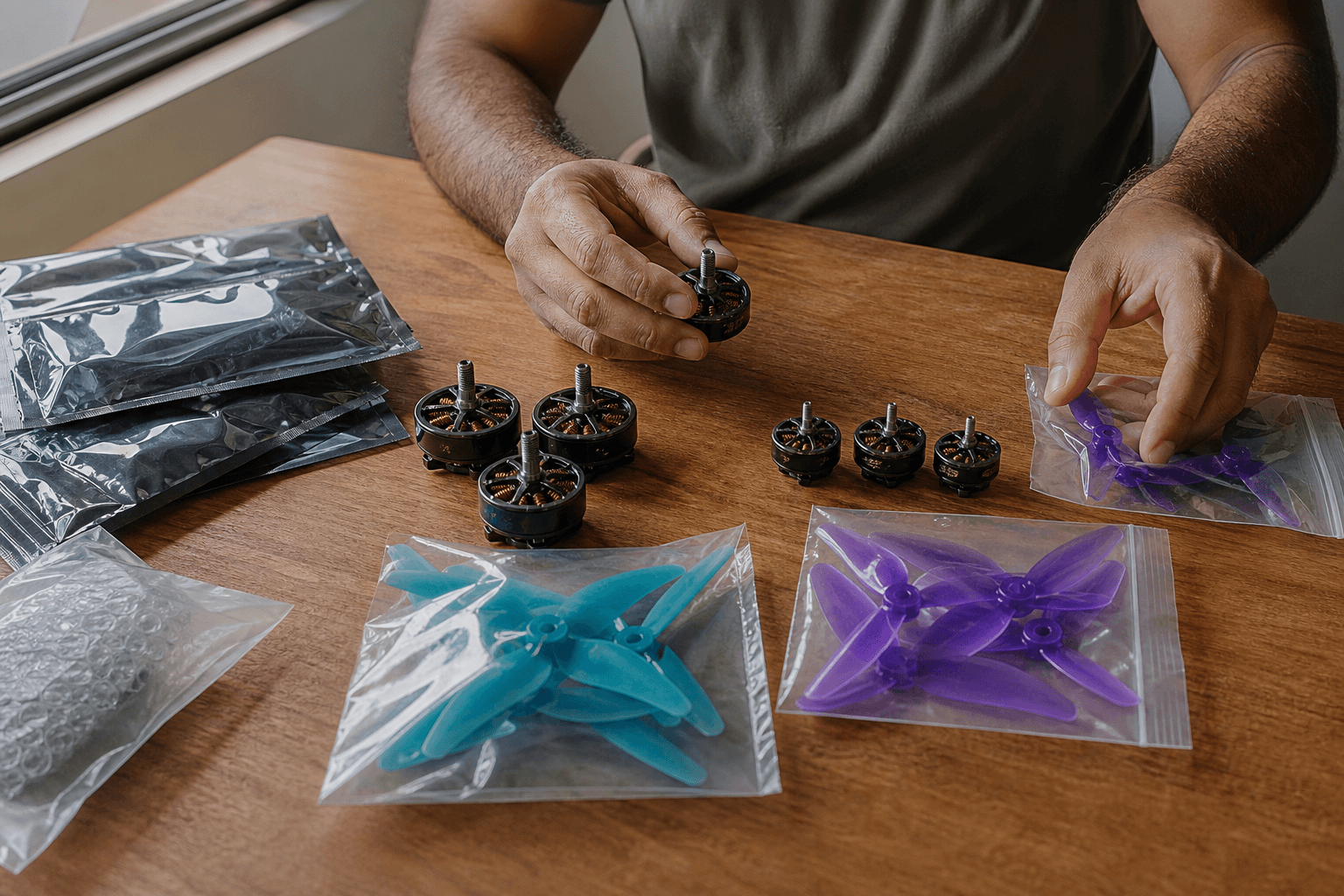
- Pick cell count you will actually run.
- Choose a prop size your frame and style want (freestyle 5" is not cinewhoop 2.5").
- Select KV and stator size that match community recipes for your approximate all-up weight.
- Buy two prop types to bracket load (efficient vs aggressive) instead of ten bags of the wrong pitch.
Worked example (conceptual, not gospel)
| Build | Starting point |
|---|---|
| 5" 4S freestyle | ~2207, KV in common 4S range, 5" triblade |
| 5" 6S freestyle | Lower KV or milder props vs 4S recipe |
| 3" park | Smaller stator, higher KV, verify amps |
| 7" cruise | Low KV, large stator, efficient props |
Copy recipes from pilots at similar weight, then log and adjust.
Cell count: pick once, build around it
4S and 6S change ESC amp stress and KV headroom. First builds often benefit from 4S; 6S needs matched KV and props from day one, not "I'll try both someday."
| Question | Lean 4S | Lean 6S |
|---|---|---|
| First freestyle build | ✅ Calmer peaks | Matched KV/props only |
| Heavy HD vtx + GoPro | Easier on marginal ESC | Lower KV or mild props |
| Indian summer heat | Less peak stress | Watch amp and shade packs |
Afternoon 38–42 °C sessions raise resistance, if OSD peaks climb with temperature on the same props, step down disc load before firmware fixes.
Order checklist:
1. Cell count fixed
2. Frame size + all-up weight estimated
3. Prop diameter fits frame with clearance
4. Motor stator + KV from recipe match
5. ESC amp rating above logged peak (not wishful)
6. Two prop profiles in cart
Logging beats myths
Math beats myths, log a few flights and you will feel prop changes before the forum does.
What to log
- OSD max current on punch-out
- Motor temp after landing
- Flight time per pack
- Throttle position feel on typical line
One prop swap with notes beats reading fifty comments. Blackbox optional for amp spikes.
Common mistakes
| Mistake | Outcome |
|---|---|
| 6S motor table on 4S without thought | Sluggish or wrong props |
| Heaviest props because they look cool | Hot ESC, short flights |
| Ignoring HD vtx weight | Re-tune forever |
| ESC sized for brochure amp, not real draw | Magic smoke |
| Ordering motors before props | Frame clearance and disc load guessed wrong |
| Matching forum KV without same weight | Hover at 90% throttle, hot every pack |
Log OSD max on your aggressive prop, add 20–30% margin for ESC shopping, brochure burst amps assume airflow you may not have in summer.
When to stop swapping and fix flying
If you are on recipe motors and third prop brand still runs hot, check mechanical issues, bent motor, ESC damage, bad solder, before fourth prop order. See building your first 5-inch for stack and wiring basics.
Bench
- Propulsion / 2207, KV and stator for your cell count
- Propulsion / 5" Prop, bracket disc load with two prop types
- the Bench, full build comparison
See also
- Building your first 5" freestyle quad, frame, stack, and first power-on
- Filter tuning for hot climates, when heat shrinks your amp and tuning margin
- Betaflight tuning basics, PID workflow after the build math is sane
Discussion
Comments aren't open on this post yet. Share it with your build group, or start a thread on X.