
LiPo safety: charging, storage, and field habits that scale

LiPo packs are the best and worst part of the hobby: incredible power density, zero patience for abuse. A boring safety routine keeps you flying instead of explaining smoke to your housemates. These habits scale from one whoop pack on a desk to six 6S packs on a parallel board, the physics does not care about your experience level.
What makes LiPos different
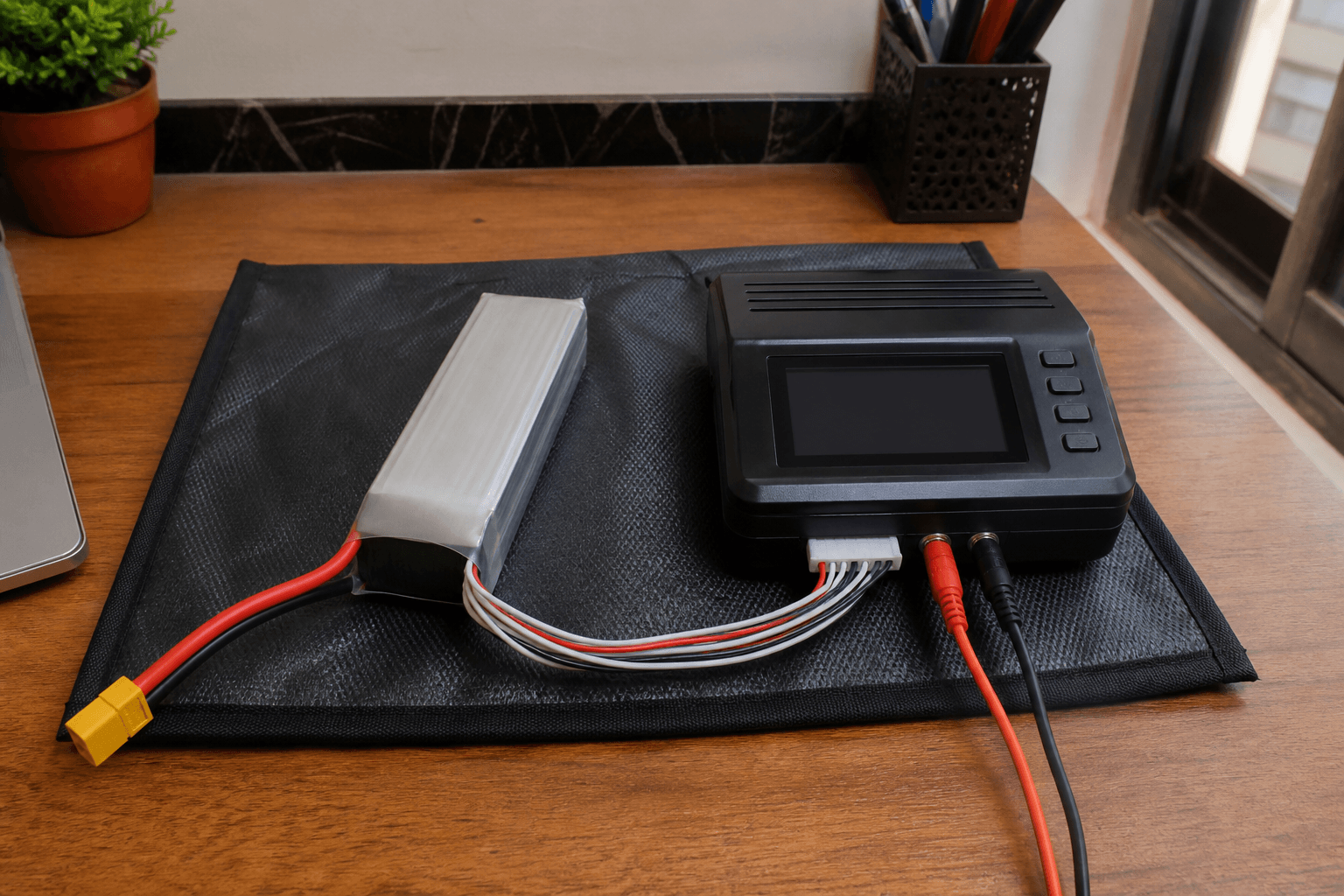
Unlike consumer gadget cells, LiPos used in FPV deliver huge burst current. That means heavier gauge wire, solid connectors, and respect for temperature and mechanical damage. Puffy cells, nicks in the foil, or crushed corners are signals to retire a pack, not "fly one more time."
| Signal | Action |
|---|---|
| Swollen pouch | Retire, do not puncture in trash |
| Torn wrap exposing cells | Retire or professional recycle |
| Bent balance lead | Replace lead or retire pack |
| One cell always low | Retire, imbalance risk |
| Hot after gentle hover | Check C-rating and charge rate, C-rating myths |
Charging fundamentals
Bench setup checklist:
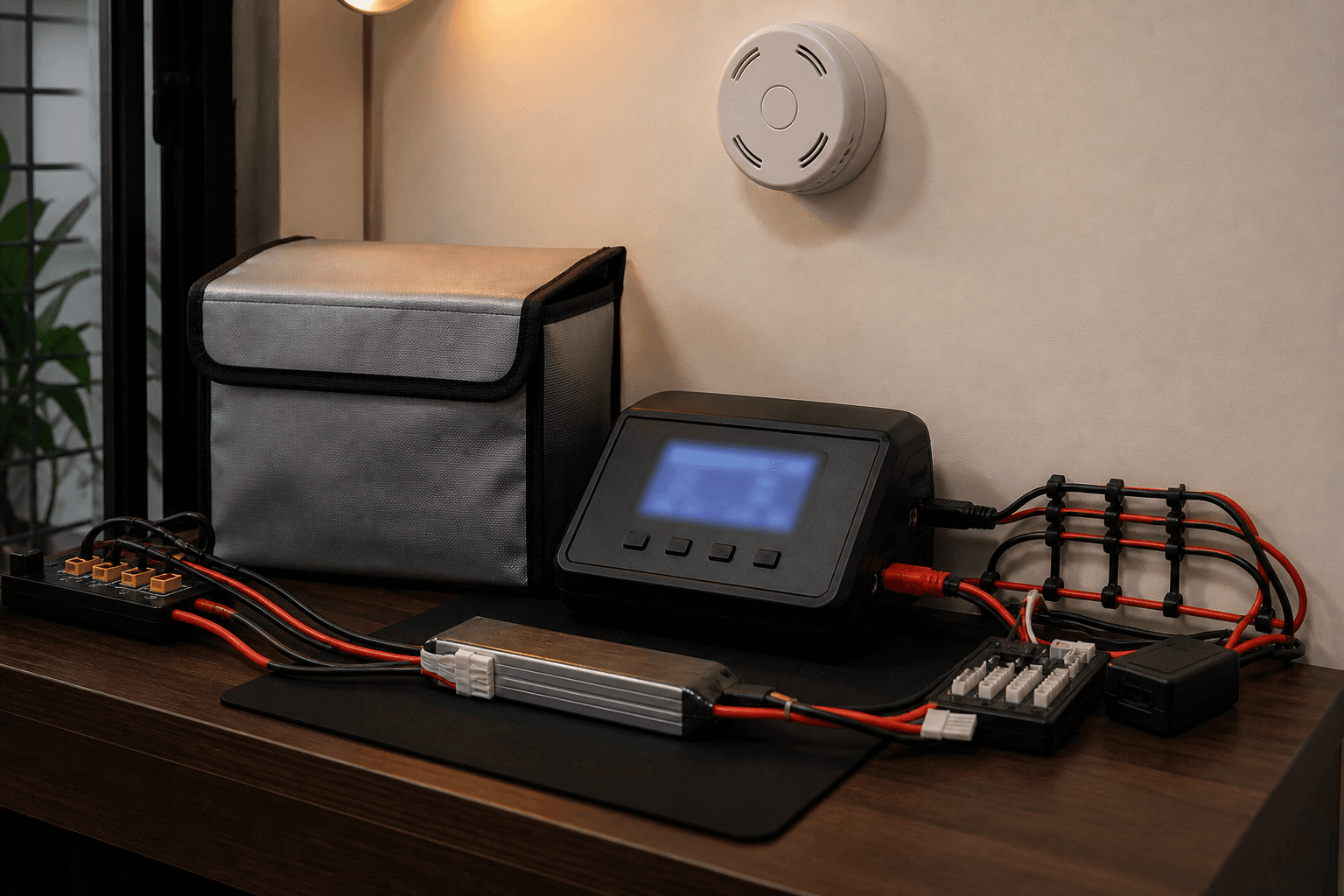
□ Fire-resistant surface (metal tray, LiPo bag, concrete)
□ Charger manufacturer firmware updated
□ Balance leads intact, no frayed wires
□ XT60 / connector not warm at idle
□ Smoke alarm in room, not a joke in apartments
□ No charging overnight unattended on unknown hardware- Use a balanced charge mode from a reputable charger; never trickle-charge blindly overnight on an unknown brick.
- Stay within the C-rate your pack and manufacturer allow. "Fast charge everything at 5C" is how people cook soft packs.
- Charge on a fire-resistant surface away from clutter. A metal baking tray or purpose-made bag is cheap insurance.
- Label your packs (date, cycles) so you know which ones owe you nothing.
Charge rate math: 1500 mAh pack at 1C = 1.5 A on charger. At 2C = 3 A. Field and summer, bias 1C when packs are warm, summer field day.
Storage voltage
Long breaks between sessions? Do not leave packs fully charged for weeks. Move them to storage voltage per your charger's profile (commonly discussed around 3.8 V per cell: always follow your charger and pack guidance). Your future self gets more consistent internal resistance and fewer surprise voltage sags.
| Situation | Target |
|---|---|
| Flying again tomorrow | Storage or full, your call if next morning |
| One week off | Storage |
| Monsoon month off | Storage + silica + cool dry room, monsoon guide |
| "I'll fly someday" | Storage, check monthly voltage |
India apartment note: storage in a hot cupboard near kitchen = bad. AC room or metal box with airflow wins.
In the field
- Let packs cool 10–15 min before charging at the next stop.
- Secure batteries in the frame so crashes do not bend the balance lead or crush the pack against carbon.
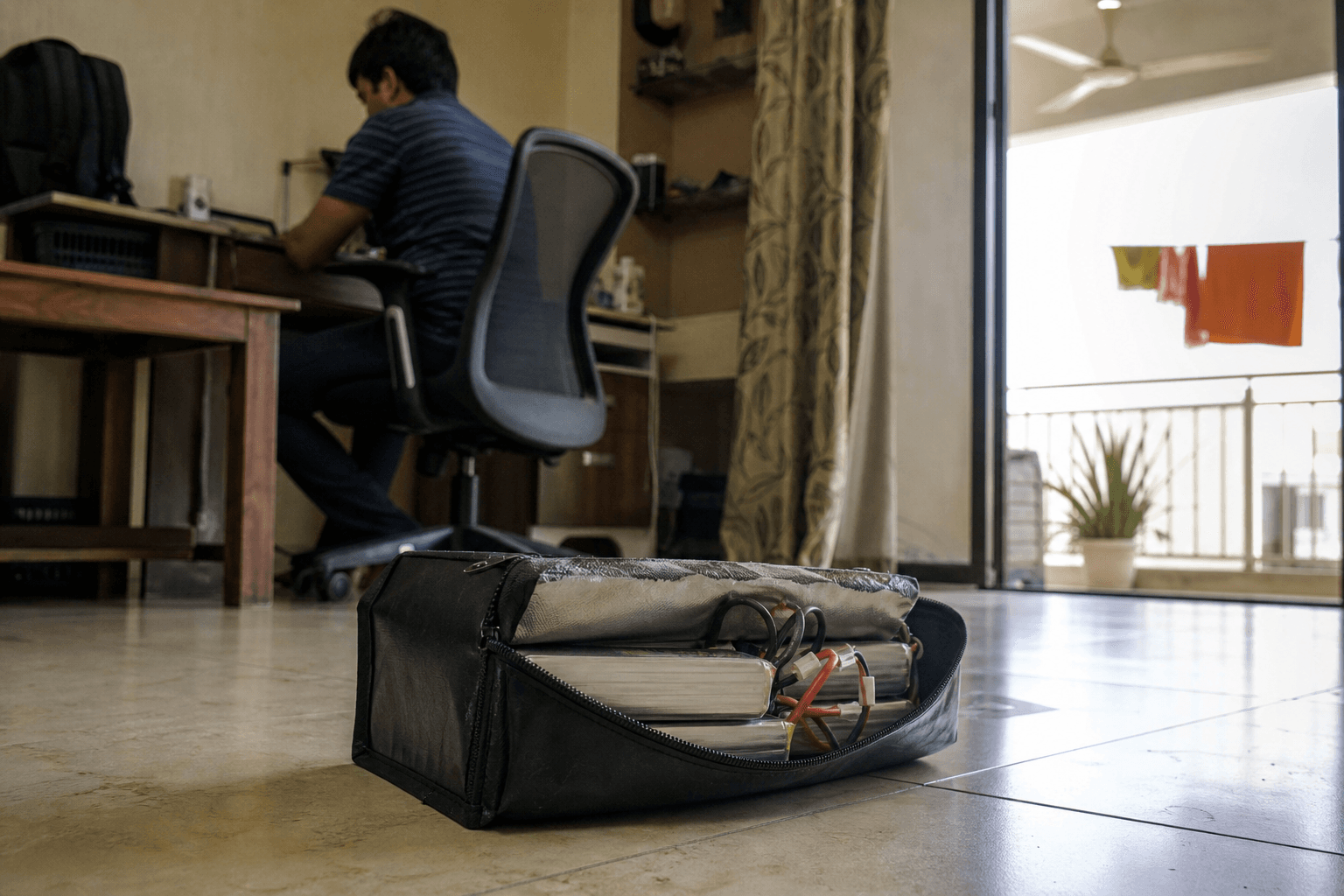
- Carry a battery bag for transport; many couriers and venues have rules, check before you ship or travel.
- Never leave charged packs in closed car: field charging with ventilation only.
Parallel charging pointer
Multi-pack bench workflow belongs in parallel charging: safe workflow, same cell count, healthy packs, fire prep. Parallel is not a hack to charge damaged cells faster.
India-specific habits
Indian summers punish batteries twice: ambient heat at the field and hot cars between sessions. Do not leave charged packs in a closed vehicle, cabin temps can push cells past comfortable storage range fast. Charge in shade or a ventilated room, not a tin shed at 2 p.m.
When ordering domestically, LiPos often ship surface only; plan flight days around arrival, not wishful tracking. If a seller will not ship LiPos to your pincode, that is policy, not a negotiation, buying gear in India covers invoices and shipping realism in more detail.
Monsoon humidity is rough on exposed balance leads and connector plating. Dry packs before storage, keep silica in your field bag if you are serious, and inspect for corrosion on XT60/PH2.0 joints after wet sessions.
GST / warranty: buy packs from sellers who invoice, grey packs have no RMA when one cell dies week two, warranty documentation.
Disposal (India practical)
Do not throw swollen packs in household waste. Options pilots use:
- Hobby shop collection (ask locally)
- Discharge to safe voltage in salt water only with proper guidance and ventilation, community methods vary; prefer shop disposal
- Store punctured-risk packs in LiPo bag until drop-off
When to retire a pack
Internal resistance climbs, voltage drops under load harder than siblings of the same batch, or visual damage appears. Cheap insurance is retiring early. A failed pack mid-flight is heavier on the wallet than a replacement.
Retire if:
□ Visible puffing
□ 3+ soft crashes on same pack
□ Cell deviation > 0.1 V after rest repeatedly
□ Connector arc marks or melted housing
□ "It still works" but smells sweet / hot
Charge slow when you can, store smart, and fly more Tuesdays. That is the whole trick.
Travel and courier checklist (India)
| Item | Rule |
|---|---|
| LiPo in carry-on vs check-in | Follow airline and carrier rules, when unsure, ask seller |
| Tape terminals | XT60/PH2.0 covered for transport |
| Storage voltage before ship | Never ship full packs if avoidable |
| Field bag | LiPo-safe pouch visible for security questions |
| Invoice in bag | Domestic purchase proof, buying checklist |
Apartment charging setup:
□ Hard surface away from curtains and paper
□ Smoke alarm functional
□ Charger on timer habit if you forget unplugging
□ No charging on bed or sofa
□ Housemates know where fire bag lives
Common LiPo mistakes (even experienced pilots)
| Mistake | Why it hurts |
|---|---|
| "Storage later" for weeks on full charge | IR climbs, puff risk |
| Parallel board with one suspect pack | Damages siblings |
| Crushed pack in tight frame | Internal short on next punch |
| Charging in closed car at field | Summer heat + fire risk |
| Ignoring sweet smell or warm idle connector | Retire pack, no negotiation |
Label packs with purchase date and cycle count. When a pack underperforms siblings from the same batch, retire early, mid-flight sag costs more than replacement.
See also
- Monsoon flying and storage in India, humidity, corrosion, and wet-field habits
- Buying FPV gear in India, GST, LiPo shipping rules, and DOA documentation
- Filter tuning for hot climates, motor and ESC heat when packs and air are both working hard
Discussion
Comments aren't open on this post yet. Share it with your build group, or start a thread on X.