

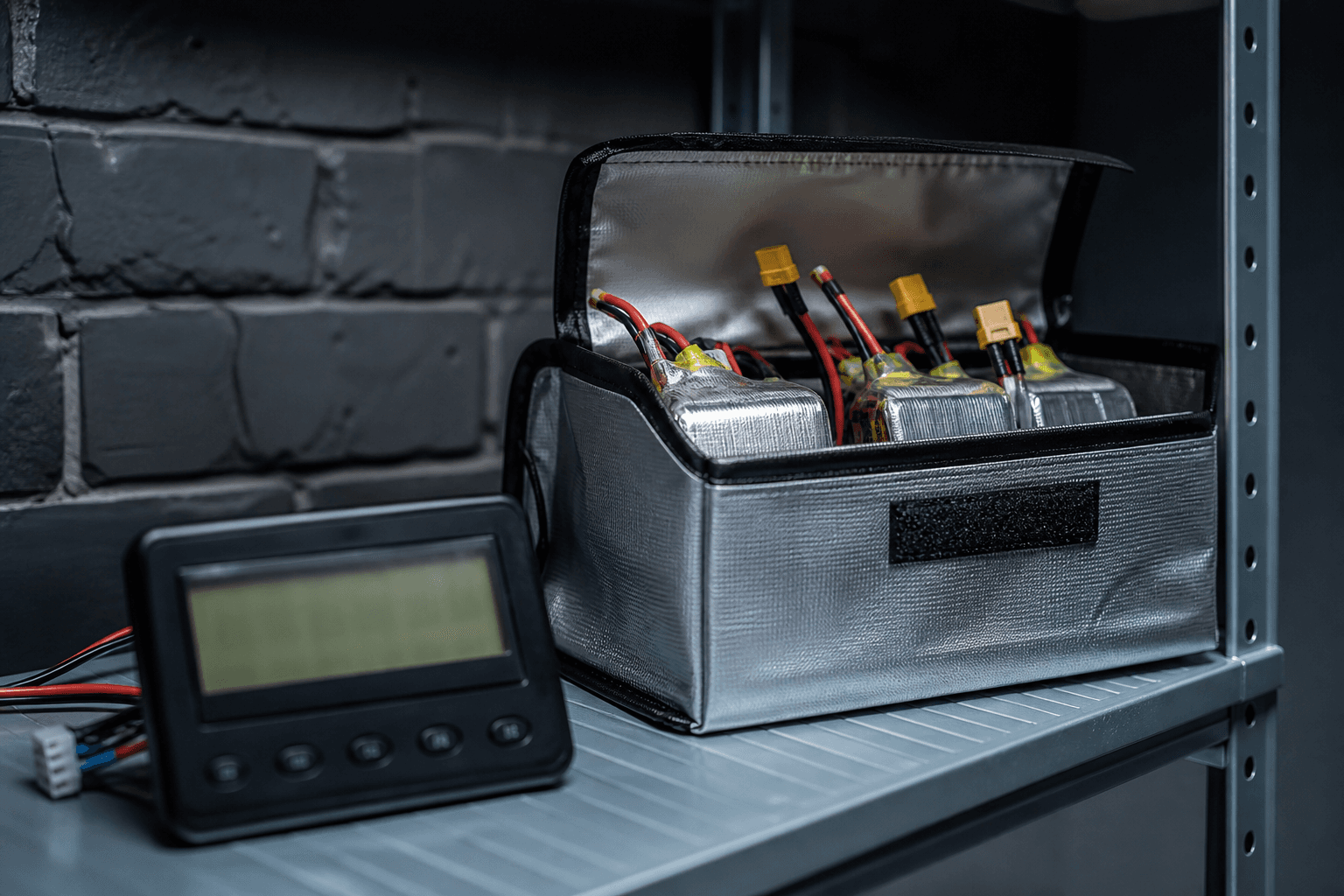
How to store LiPo batteries

Storage is where packs quietly die, or start fires. A whoop fleet left full on a balcony through an Indian summer will puff and lose capacity. Treat storage as part of every flight day, not an occasional maintenance job.
Pair this with how to charge a LiPo safely and the full LiPo safety guide. The India angle: heat, monsoon humidity and slow surface-only restocking mean storage habits matter more here than in a cool climate.
Storage checklist
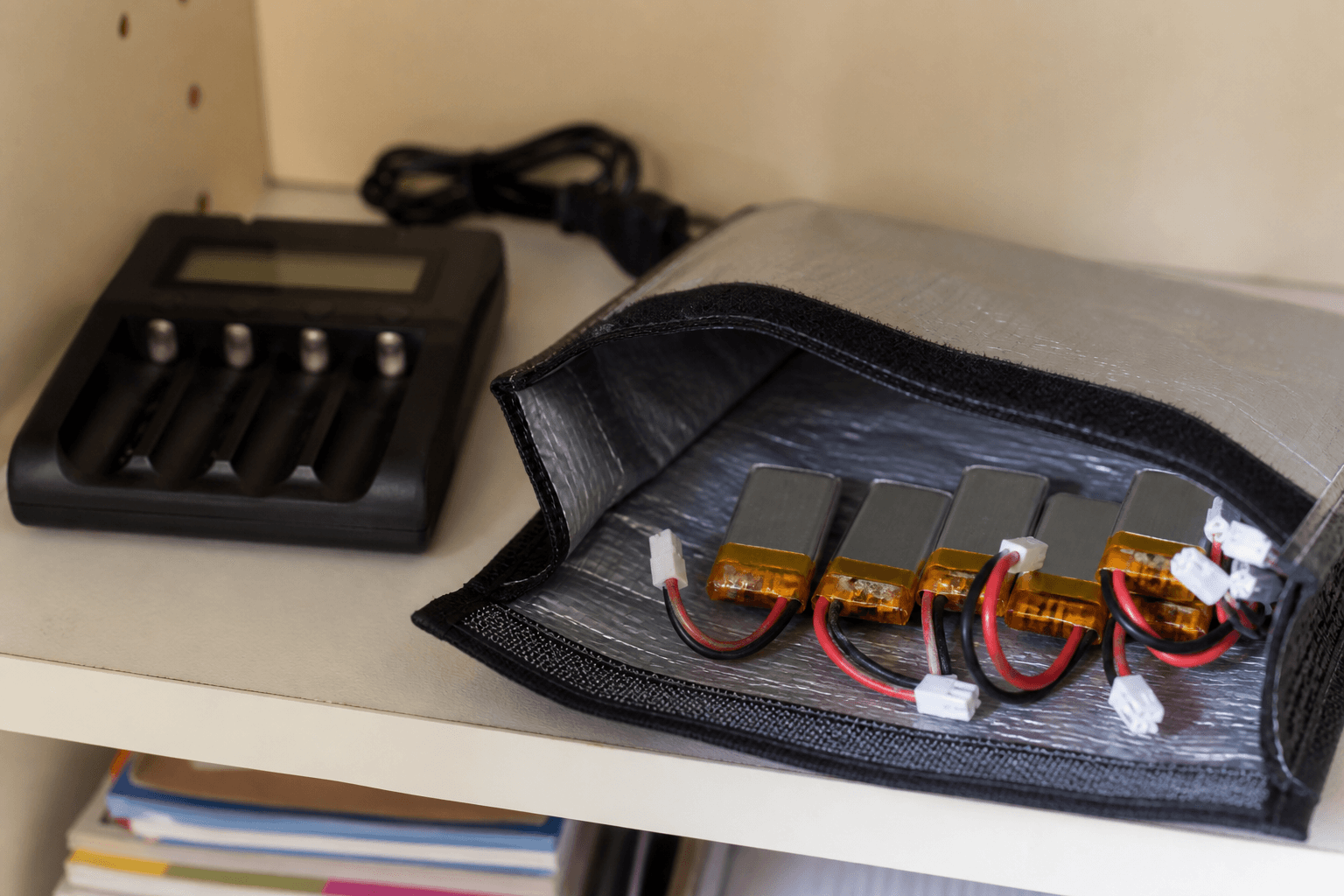
- Bring packs to storage voltage (about 3.8V per cell; 3.8–3.9V for LiHV) if they will sit more than a day or two
- Keep packs in a LiPo bag / ammo can on a non-flammable surface
- Cool and dry: not a parked car, not a sunny balcony, not under a dripping AC
- Inspect for puffing, odour or damaged leads before the next charge
- Dispose of damaged packs properly, never in household trash (disposal guide)
Flight-day vs shelf
| Situation | Pack state | Why |
|---|---|---|
| Flying in a few hours | Full charge ok | Capacity ready, time short |
| Next weekend | Storage voltage | Full for days ages cells |
| Unused for weeks in the monsoon | Storage + inspect | Humidity and heat are hard on packs (monsoon storage) |
| Travel / hotel | Storage + bag | Carry LiPos traveling |
Rough targets many chargers label for you:
| State | ~V per cell | Use |
|---|---|---|
| Storage | ~3.8V (LiHV 3.8–3.9V) | Sitting |
| Full | 4.20V (LiHV 4.35V) | Flying soon |
| Empty / soft | ~3.5V and falling | Land; do not store empty either |
Many whoop packs, including BetaFPV’s BT2.0 1S packs, are LiHV: they charge to 4.35V. Set your charger to the right mode for the pack.
Do not leave packs full for weeks, and do not store them empty either. Storage voltage is the safe middle.
Where to put the bag
Good:
□ Hard floor / tile, away from beds and curtains
□ LiPo bag or metal ammo can
□ Room that stays cooler than a closed car

Bad:
□ Scooter under-seat in summer
□ Balcony shelf in direct sun
□ Charging bag on a mattress "just this once"
□ Loose packs mixed with tools that can puncture pouches
Summer field packing still applies at home: heat kills packs - summer heat packing list.
Whoop fleet tip
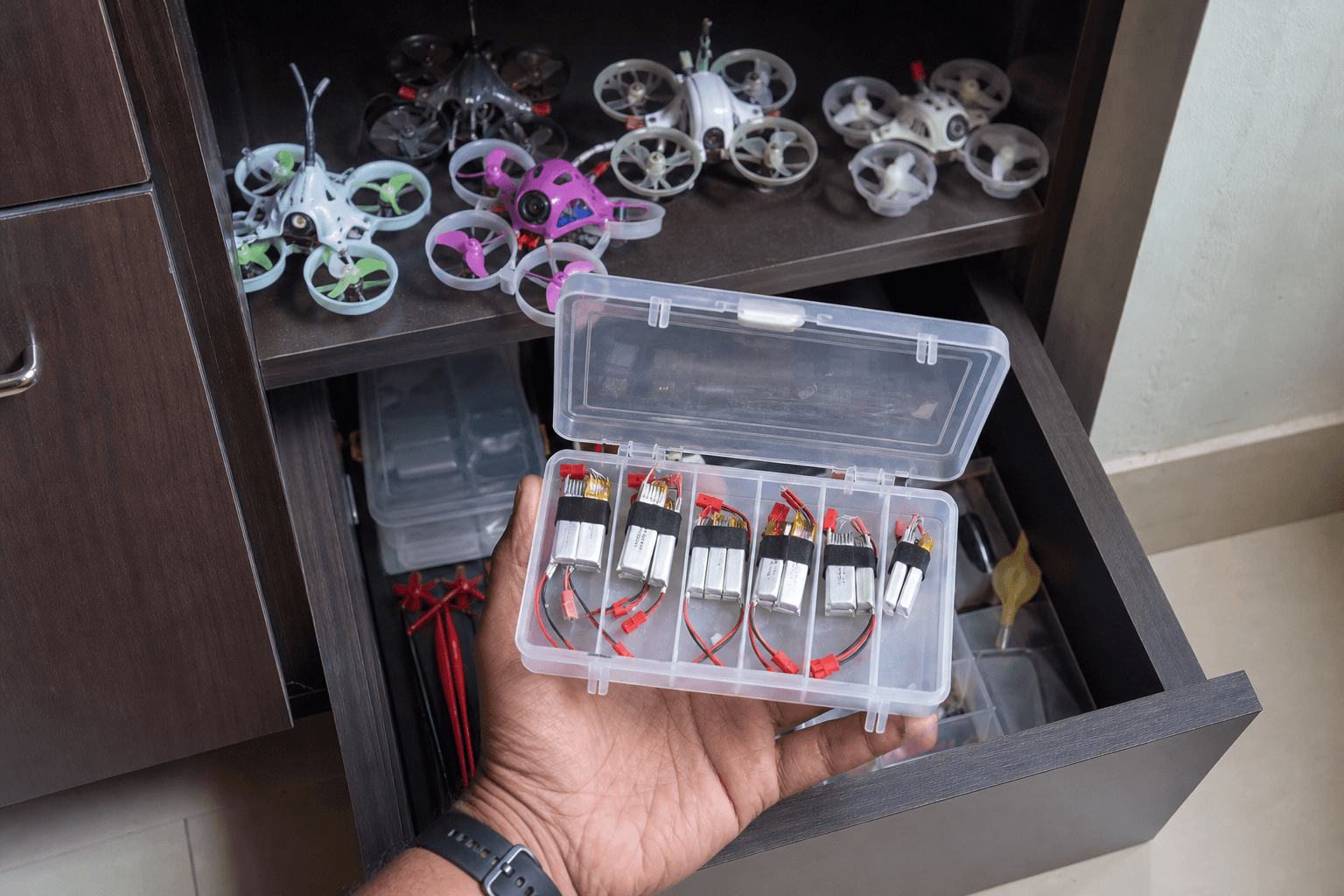
Label packs and rotate them. A favourite pack that always goes first wears out early while the “backups” sit full or forgotten.
Fleet habit:
1. Number packs 1–N with tape
2. Fly in order; retire soft packs from the rotation
3. After the session, storage-charge the ones not flying tomorrow
4. Log which packs puff or sag early
How many to own: how many LiPo batteries for FPV. Lifespan reality: how long do LiPos last.
Failure modes
| Mistake | What happens |
|---|---|
| Full packs on a shelf for a month | Capacity loss, higher puff risk |
| Storage forgotten after field day | Same - “I’ll do it tomorrow” becomes three weeks |
| Hot car / balcony | Worn packs, softened connectors, fire risk |
| Charging in the storage bag unattended | Bag is not a license to walk away |
| Swollen packs in the same bag as healthy ones | A failing pack can take the others with it |
| Ignoring a puffed whoop pack “it still flies” | Next charge is the dangerous one |
India restock note
Expect surface shipping when you order packs (LiPo shipping rules India). That delay is why storage habits and a 4–6 pack fleet matter: you cannot get replacements overnight after you cook three packs on a terrace.
Connector match still applies when you restock: BT2.0 vs PH2.0.
Weekly 5-minute ritual
□ Any pack above ~4.0V/cell and not flying soon → storage
□ Visual puff / lead check
□ Bag closed, clear of clutter
□ Charger unplugged if idle
□ Soft packs marked for retirement / disposal
Bench
Whoop packs on the Bench. Charge safely, store carefully, fly more often.
See also
- Puffed LiPo battery: what to do
- Parallel charging safe workflow
- Field charging from car power
- C-rating myths
FAQ
- How should I store LiPo batteries between flight days?
- At storage voltage, about 3.8 V per cell (3.8 to 3.9 V for LiHV packs), inside a LiPo bag or metal ammo can on a hard non-flammable surface in a cool, dry room. Inspect for puffing, odour or damaged leads before the next charge.
- Is it bad to leave LiPo batteries fully charged?
- Yes if it is for more than a day or two. Full packs age faster and puff sooner, especially in Indian heat (many makers say no more than about three days). Charge full only when you are flying within a few hours; otherwise bring them to storage voltage after the session.
- Where should I not keep LiPo batteries in India?
- A scooter under-seat in summer, a balcony shelf in direct sun, a closed parked car, a bed or mattress, and loose with tools that can puncture the pouch. Heat is the main pack killer; monsoon humidity argues for dry storage and clean connectors.
Discussion
Comments aren't open on this post yet. Share it with your build group, or start a thread on X.