
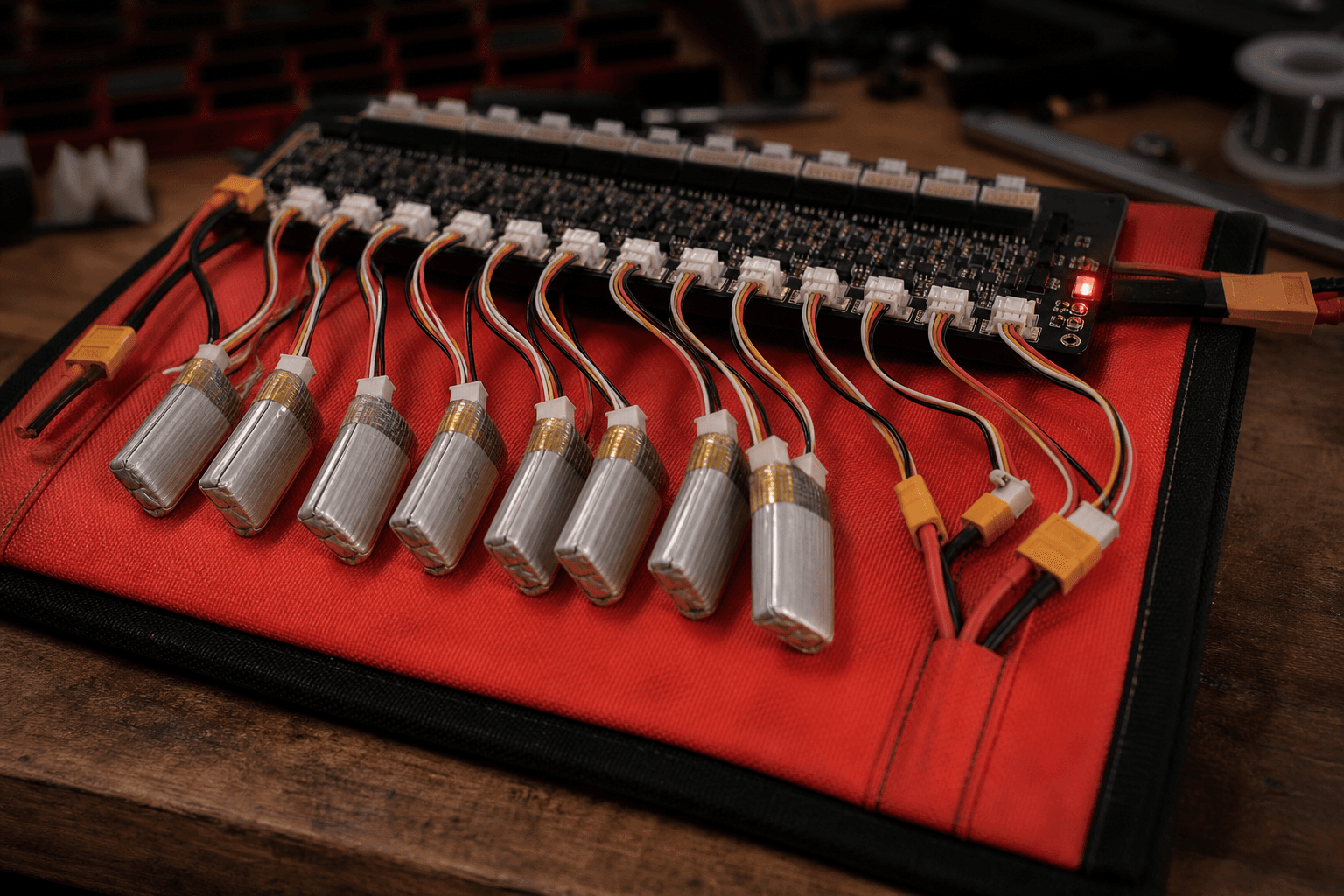
Parallel charging: safe workflow

Parallel charging multiplies throughput, it also multiplies mistakes if cell counts or damaged packs sneak in. Done right, it is the standard way Indian pilots feed a 4–6 pack weekend without owning six separate chargers. Done wrong, it is how forums get "what happened?" photos.
What parallel charging actually does
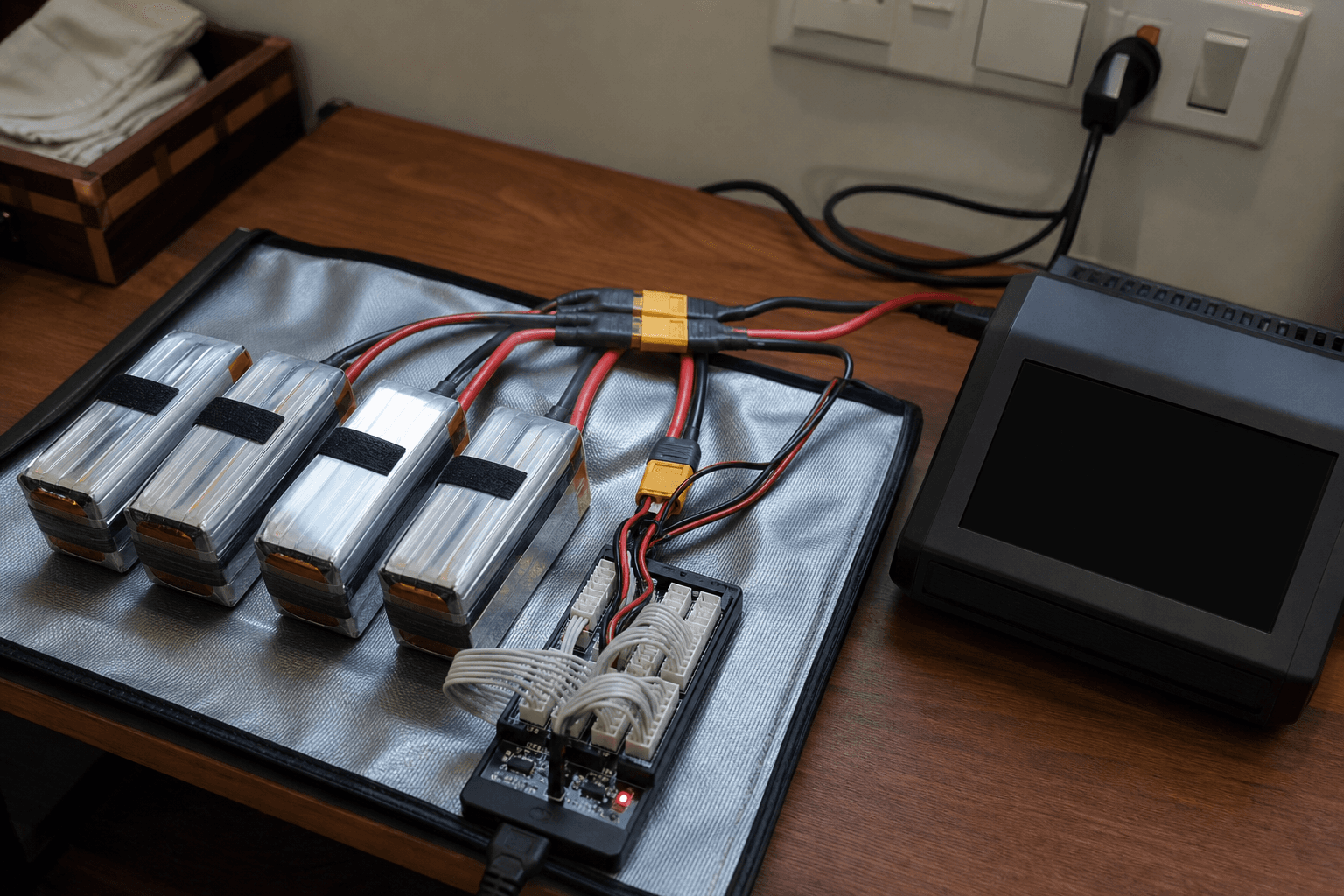
A parallel board ties same-numbered cells together, all cell 1s connect, all cell 2s, etc. The charger sees one large pack. Voltage must be close at plug-in or current rushes between packs to equalize, heating wires and stressing cells.
Golden rules
- Same cell count only: never parallel 4S with 6S
- Similar voltage at plug-in, large deltas = stress; many pilots target within 0.1 V per cell
- Capacity spread reasonable, community often cites ~2× spread max (1500 mAh with 3000 mAh); tighter is better
- Healthy packs only: no puffy, no crash victims, no "one cell always low"
- Same chemistry: LiPo with LiPo; do not mix Li-ion, see Li-ion long-range
Pre-flight board inspection
Monthly:
□ Trace wires firm on board
□ No discolouration on XT60 main leads
□ Balance plug pins straight, no corrosion
□ Fuse on board (if present) correct rating
□ Board on non-flammable surface, not carpet
Fire prep
- Charge on non-flammable surface, tile, concrete, metal tray
- LiPo bag open top nearby, not sealed around charging heat
- Never leave room, parallel is not "set and forget"
- Extinguisher or sand bucket if you charge in garage
- India summer, no charging in closed car
- Apartment: charge when someone else is home; smoke alarm active
Workflow (step by step)
1. Label packs, date, cycles, mAh on tape
2. Resting voltage check each pack, within 0.1 V/cell of group
   → If not: balance charge individually to storage first
3. Plug balance leads to board, then main XT60 to charger
4. Charge current = sum of per-pack safe rates (usually 1C each max)
   Example: 4× 1500 mAh @ 1C → 6 A total charge current
5. Standby, eyes on first 2 minutes (warm lead = STOP)
6. Unplug main first when done; balance last
Voltage delta table (rule of thumb)
| Delta per cell at plug-in | Action |
|---|---|
| < 0.05 V | OK to parallel |
| 0.05–0.1 V | OK if same brand/age; watch amps |
| 0.1–0.2 V | Balance charge individually first |
| > 0.2 V | Do not parallel |
Common mistakes
| Mistake | Consequence |
|---|---|
| 4S + 6S "only for a minute" | Fire / destroyed packs |
| Crash-dented pack "still balances" | Thermal runaway risk |
| Max amps because "charger allows it" | Hot balance leads |
| Charging in bedroom overnight | You are the smoke alarm |
| Wet hands monsoon plug-in | Arc, damaged board, monsoon |
vs field charging
Parallel is bench workflow; car charging is different math, usually one or two packs conservative on DC. Parallel board on inverter in a hot trunk is a bad combo.
India buying note
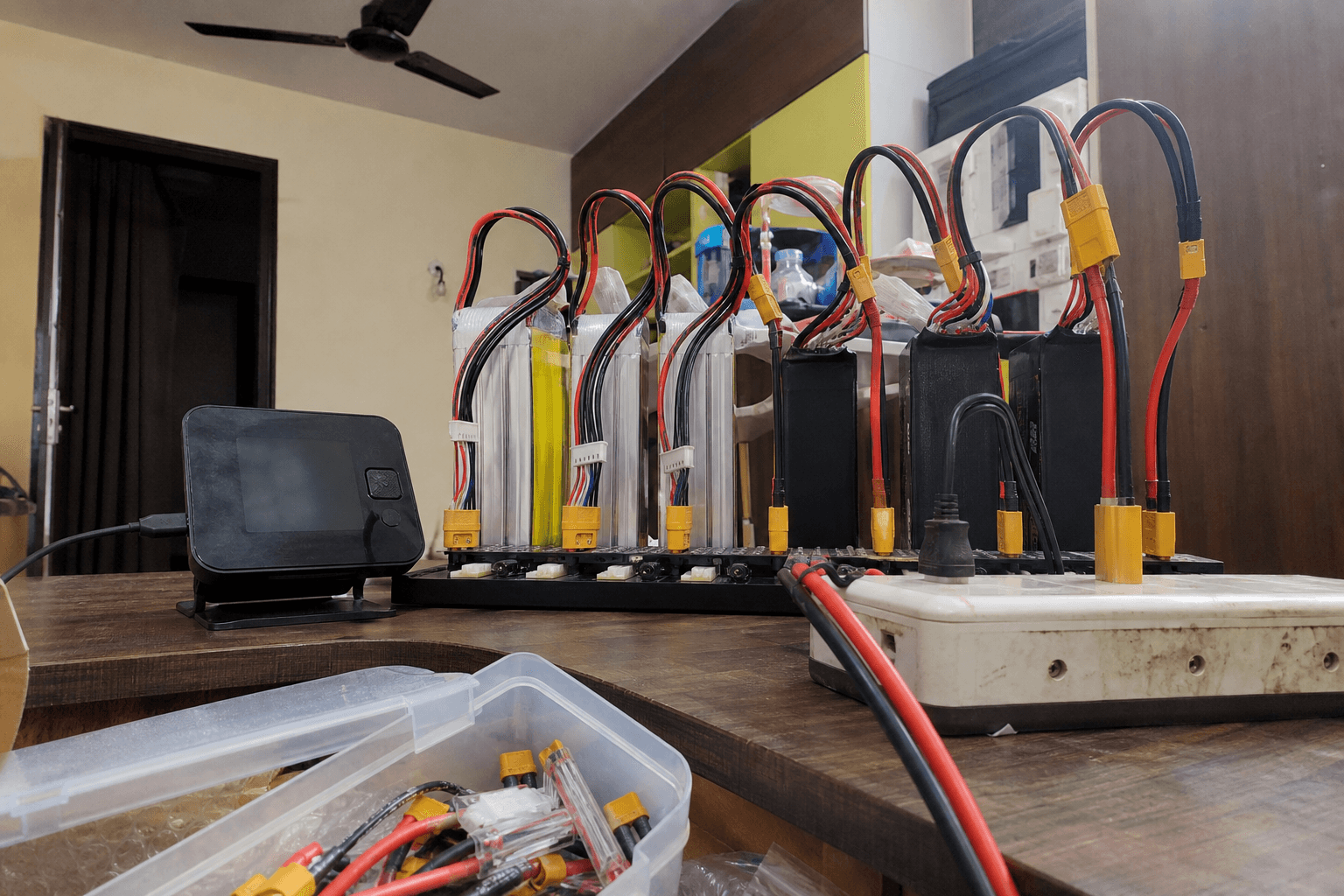
Buy parallel boards from reputable domestic sellers with invoice, cheap boards with thin traces age poorly. Buying checklist, GST and pincode. Main lead gauge matters at 6S high-amp parallel.
When NOT to parallel
- Learning week one, single-pack charge teaches voltage reading
- Any pack you do not trust
- After monsoon soak without dry period
- When room is above 35°C and no airflow, LiPo safety
Parallel charging should be boring. If it is exciting, unplug.
First-time parallel setup (week one)
Day 1, single pack charge only; learn charger menus
Day 2, second pack; compare resting voltages
Day 3, two matched packs parallel at 1C total
Day 4, add third pack only if voltages match
Day 5+, never skip voltage check to save time
Skipping this ladder is how new pilots plug 4S and 6S because the board "has slots."
Apartment charging etiquette (India)
- Inform family someone is on battery watch
- No parallel on bedding or curtains nearby
- Charge after dinner when you are awake, not 2 a.m.
- Society power cuts, charger resume behaviour: know if yours continues safely after outage
Connector maintenance before parallel
| Connector | Check |
|---|---|
| XT60 | No melt marks; tight housing |
| Balance JST | Pins straight; not brown |
| Board main leads | No warmth at idle before charge |
Connector guide, monsoon corrosion kills balance accuracy.
Charge current table (4S example)
| Packs parallel | mAh each | 1C total | 2C total (max sane) |
|---|---|---|---|
| 2 | 1500 | 3.0 A | 6.0 A |
| 4 | 1500 | 6.0 A | 12.0 A |
| 4 | 1300 | 5.2 A | 10.4 A |
Set charger below table if wires warm, room is hot, or packs are not same batch. C-rating labels do not raise your home wiring rating.
Post-charge handling
Finished parallel session is not "throw in bag." Let packs rest to ambient before sealing in LiPo bags, heat plus sealed plastic traps moisture in monsoon cupboards.
After parallel charge:
1. Unplug main XT60 first
2. Balance leads last, one at a time if board is tight
3. Rest 10–15 min before flight or storage
4. Storage voltage if not flying same day
5. Log any pack that warmed more than siblings, retire candidate
Warm balance leads on one pack only, mark that pack, solo charge next time, do not return it to the group until voltages match at rest.
Board storage off-season
Parallel boards live dry. Coil leads without sharp bends; inspect JST housing for pin push-back. A board that took a drop may have cracked trace, meter continuity on main leads before first autumn session. Store away from soldering flux and solvents; corrosion on balance traces causes false cell readings.
Logging pack batches
Label purchase batch on tape, "Oct domestic 4S batch A." Parallel works best within batches that aged together. Mixing a two-year-old pack with fresh cells invites balance surprises even when resting voltage looks close.
If one pack in a group always finishes charging hotter, retire it from parallel rotation, solo balance cycles tell the truth.
Discussion
Comments aren't open on this post yet. Share it with your build group, or start a thread on X.