
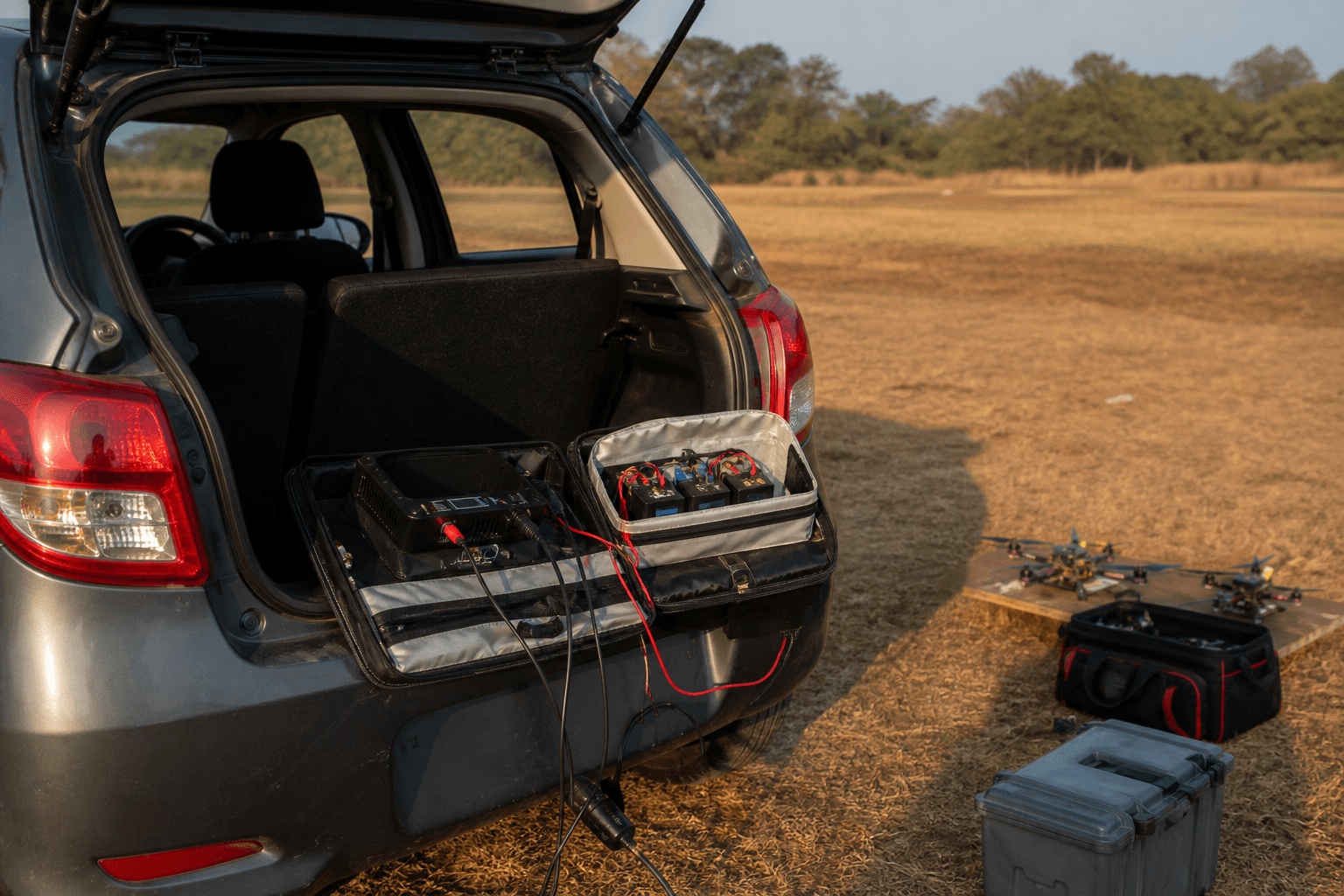
Field charging from car power

Field charging turns a parking lot into a second session, it also turns a hot car into a LiPo oven if you are careless. Indian fields are often no mains power: empty plots outside the city, farm tracks, club strips with only a shed. Car power is the default multi-pack solution, if you respect amps, ventilation, and monsoon connectors.
Options compared
| Setup | Efficiency | Cost band | India notes |
|---|---|---|---|
| DC input charger (12 V) | High | Mid | Preferred: less heat, less load |
| Inverter + AC charger | Lower (~85%) | Mid | Fan noise; cheap inverters clip |
| Portable power station | Good | High | Heavy; air travel awkward |
| Small generator | N/A | High | Rare for FPV; fumes + etiquette |
| Club mains | Best | , | Ask before assuming |
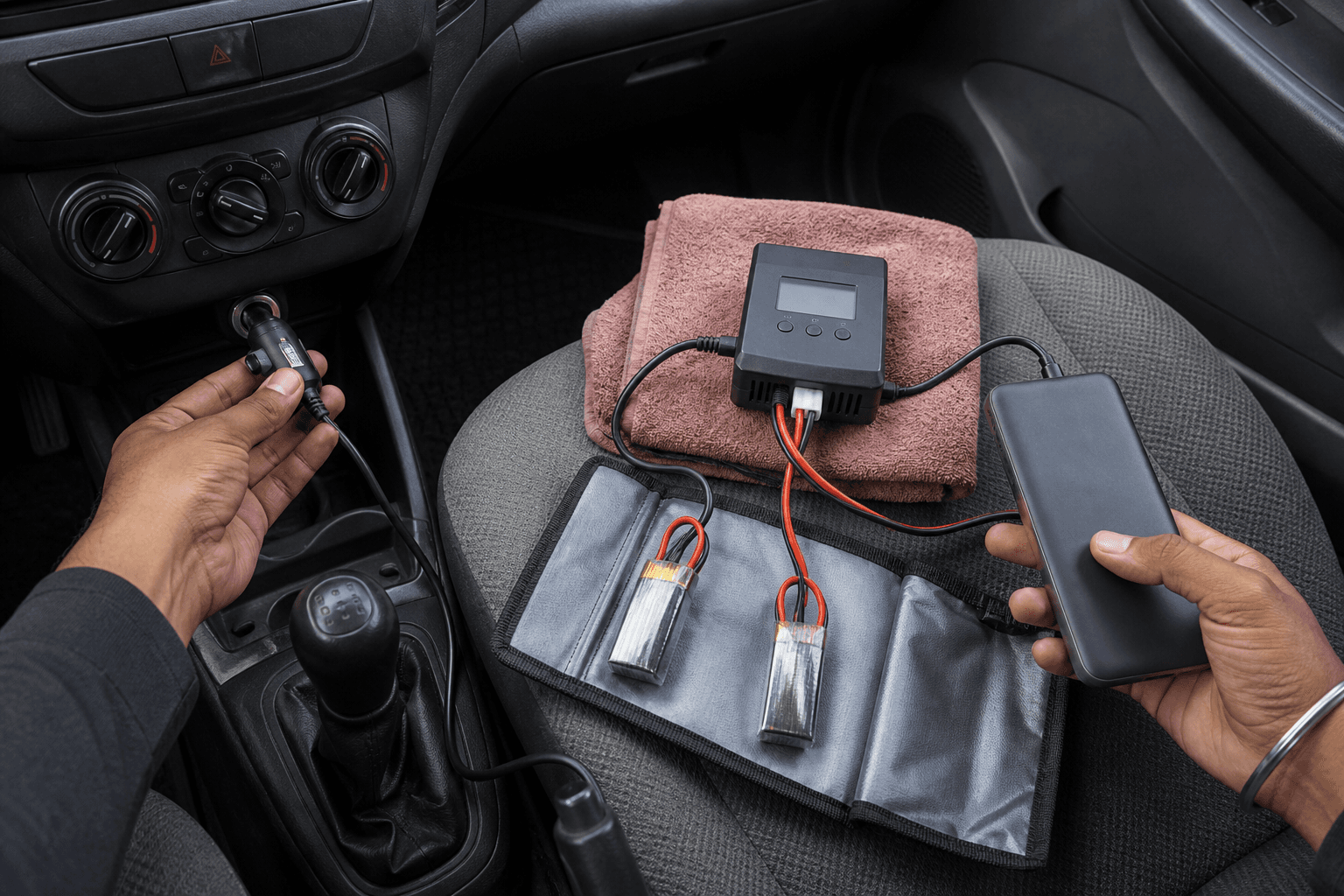
DC charger example workflow: ISDT Q6 Nano class on cigarette lighter or direct clamp to battery (with fuse), set conservative amps. Two 4S 1500 mAh at 1C each = ~3 A charge input math, do not ask the car for 20 A.
Car electrical habits (India)
Before field day:
□ Know fuse rating for 12 V outlet
□ Extension cable length, voltage drop on thin wire
□ Engine running policy, alternator vs battery-only
□ Inverter watt rating > charger display + 20% headroom
□ Ground mat so charger never sits in dust/water- Engine running vs battery-only, idling charges alternator; deep discharge on old cars is real
- Monsoon humidity: connectors and inverter placement dry; monsoon storage
- Summer: cabin heat while charging is dangerous, LiPo safety, doors open, packs in shade
- Dust (summer north), filter inverter intakes; brown layer conducts poorly on XT60
Current discipline
Charge at conservative amps: car circuits are not infinite. One charger sane beats three angry.
| Mistake | Result |
|---|---|
| 10 A on cigarette lighter | Blown fuse mid-session |
| Three chargers one inverter | Thermal shutdown |
| Charging in closed boot | Heat + gas risk |
| Damaged pack on parallel board | Parallel rules, bench only when healthy |
Rule of thumb: one quality charger at 1C per pack on a parallel board (matched cells) OR single pack at 1–2C. Field is not the place to discover your parallel board wiring is wrong.
Placement and etiquette
Park:
- Downwind edge of field, fumes and inverter whine away from pilots
- Not blocking club access road (Indian fields = narrow tracks)
- Visible fire extinguisher / sand if club provides
- Fuel cans away from LiPo bag, same culture as smoking distance
Park edge of field; fumes and noise away from pilots lining up gates. Fuel and LiPo respect same distance culture. Ask field lead where cars go, some clubs ban charging near flight line.
Monsoon-specific
- Wet inverter on damp mat: elevate; GFCI if using extension from club mains
- Condensation when AC car meets humid air, dry hands before plugging XT60
- Never charge packs that took direct rain without 24 h dry, monsoon guide
Summer-specific
Combine with summer packing list:
- Canopy for charger station
- Cooler bag for waiting packs, not charging inside sealed box
- Charge after packs cool from flight, hot charge = puffing
Li-ion long-range note
Li-ion packs charge slower and cooler, still follow chemistry profile, not LiPo presets.
Safety checklist (every session)
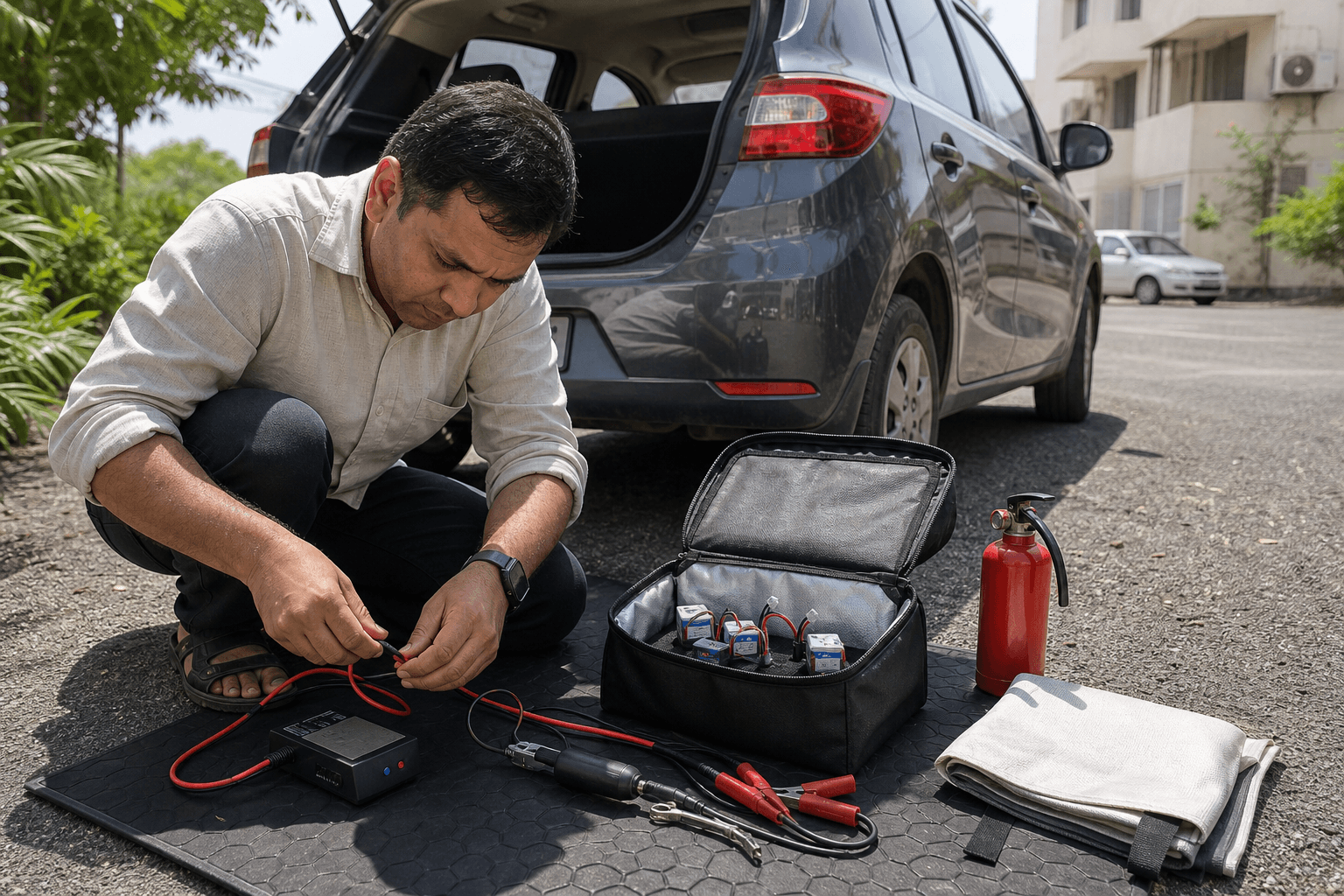
□ Healthy packs only, no crash victims
□ Same cell count on parallel
□ LiPo bag under charger
□ Pilot stays within arm's reach, no "charge while flying"
□ Kill switch: keys out if using clamps on battery terminals
When car power is not enough
Crew day with six pilots: rotate charger queue, pre-charge at home on parallel board, or split morning / evening sessions instead of midday inverter heroics. Building a field repair kit, add spare fuses and one extension cord rated for load.
Sample session math (4S freestyle)
| Item | Value |
|---|---|
| Pack | 1500 mAh 4S |
| Safe field charge | 1.5–3 A |
| Time 3.7 V → 4.2 V | ~25–40 min at 2 A |
| Packs per car session | 2–4 with rotation |
| Engine idling | ~20 min per pack batch, fuel cost vs mains |
Underestimating time leads to rushing amps: the failure mode is hot leads, not slow flying.
Inverter vs DC: India buying note
| Buy from | Check |
|---|---|
| Domestic shop | GST invoice; fuse spec on inverter |
| Import inverter | Landed cost, import guide |
| DC charger | 12 V input max amps vs car outlet |
Cheap inverters clip on startup inrush, charger fans stutter; that is a sign to derate or upgrade.
Monsoon parking: avoid charging with hood under dripping tree cover, water on inverter is not a speed run. Dry mat, tilted drip edge, same as monsoon field habits.
Clamps vs cigarette lighter
| Connection | Best for | Watch for |
|---|---|---|
| Cigarette lighter socket | 2–5 A DC chargers | Fuse rating on door sticker |
| Direct battery clamps | Higher amp DC | Reverse polarity; ventilated area |
| Inverter on lighter | Usually avoid | Undersized for 10 A+ chargers |
Clamp directly to battery terminals only with proper polarity, fused leads, and ventilation. Keys out when not actively charging unless you understand alternator load. Cheap clamp cables heat at Indian summer ambient, upgrade gauge before blaming the charger.
Multi-pilot charger queue
Six pilots, one inverter: publish a queue on paper, cap each session at 2 A per pack, and rotate flying while charging. Arguments over amps blow fuses and friendships. Pre-charge at home on parallel board so car work is top-up, not full 0–100% for every pack.
Club culture: whoever owns the inverter sets amp rules, respect them or bring your own DC setup.
Battery health before car top-up
Do not fast-charge crash-suspect packs in a hot boot because mains is far away. Solo slow charge at home first; car session is for healthy rotation. A puffing pack in a sealed boot is an evacuation problem, not a tuning problem.
Discussion
Comments aren't open on this post yet. Share it with your build group, or start a thread on X.