
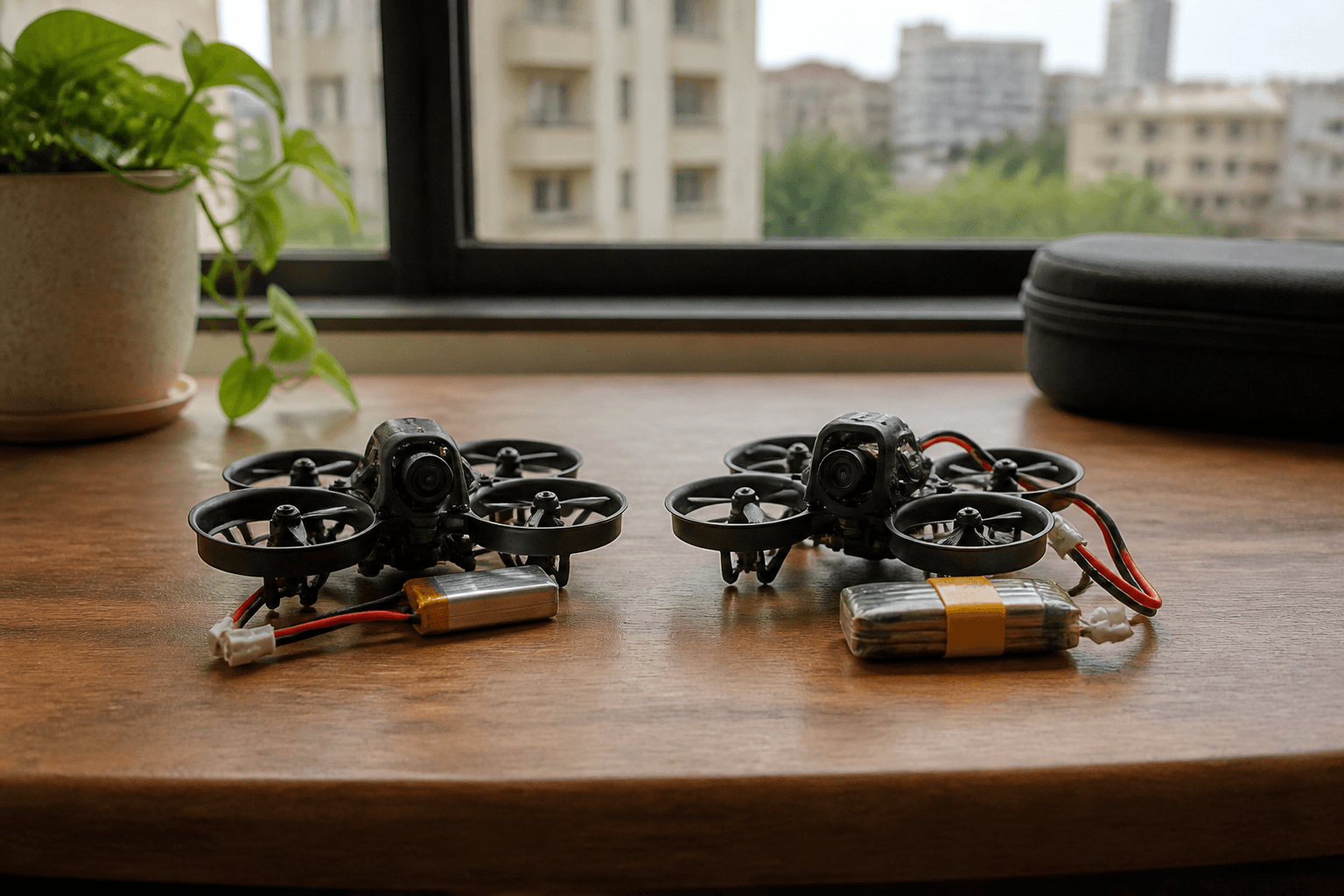
1S vs 2S whoops explained: weight, punch, and which to build first

"Should I go 2S?" is the second question every whoop pilot asks, usually about two weeks after the first hover. The honest answer: 1S teaches you to fly, 2S rewards you once you can. Here is the actual difference, without the forum mythology.
What cell count really changes
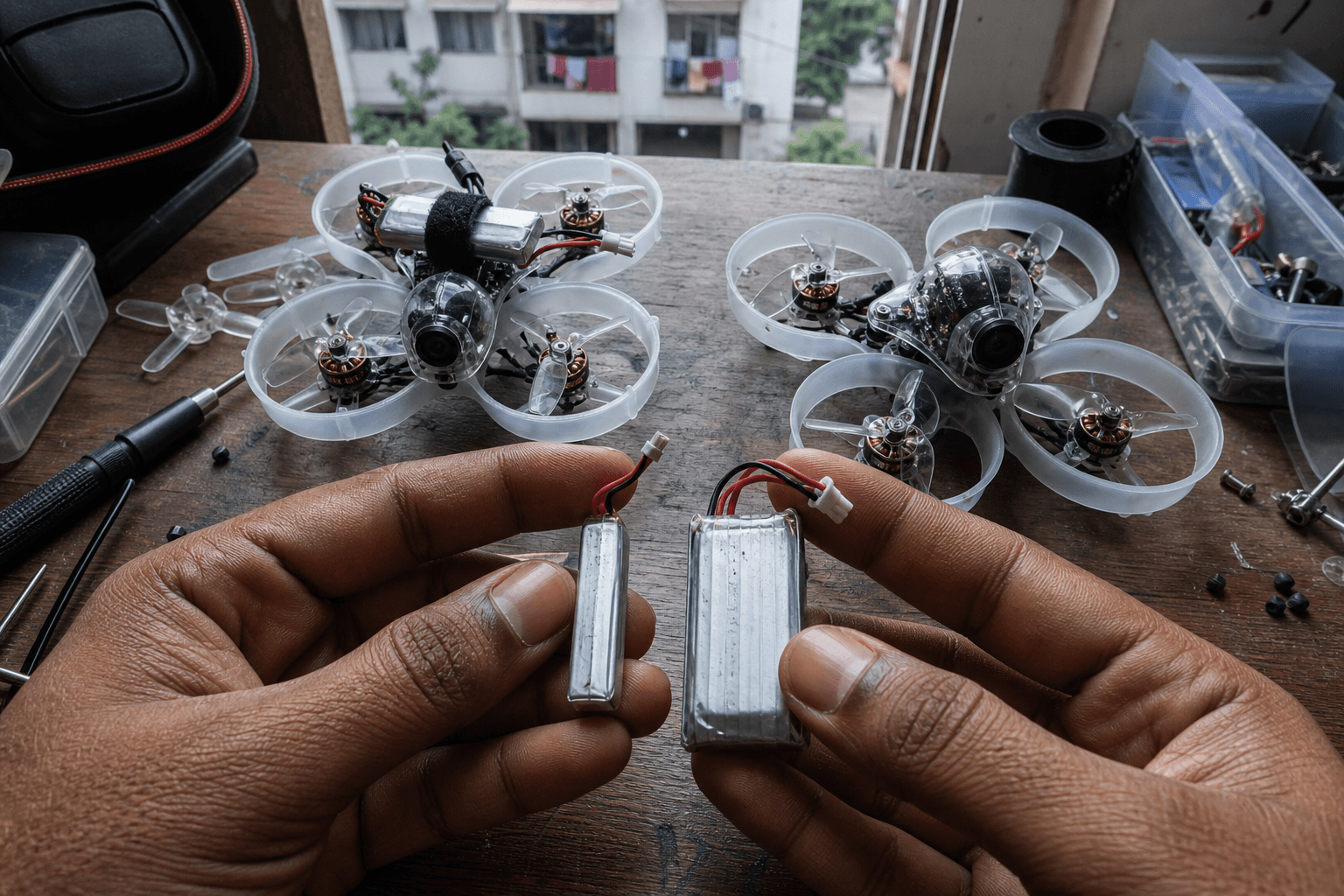
Voltage is headroom. A 2S pack doubles the voltage into the same physics problem, which cascades through the whole build:
| 1S (~3.7–4.35V) | 2S (~7.4–8.7V) | |
|---|---|---|
| Class weight | 20–28g dry | 30–40g dry |
| Feel | Floaty, forgiving | Punchy, locked-in |
| Flight envelope | Indoors, calm terraces | Parks, wind tolerance |
| Motor KV | High (19,000–25,000KV) | Lower (~8,000–12,000KV) |
| FC/ESC | 1S AIO, 5A fine | 2S-rated AIO, 12A class |
| Crash cost | Props | Props + occasional frame |
The KV inversion trips up first-time upgraders: higher voltage wants lower KV. A 1S motor on 2S is a smoke event, not an upgrade, the motor KV and throttle headroom guide explains the math.
Why 1S first
- Crash economics. You will hit everything for a month. 1S whoops bounce; 2S whoops arrive with enough energy to break what they hit, including themselves.
- Indoor legality of space. Most Indian pilots start in apartments and on terraces. 1S is the class that stays welcome there.
- Skill transfer. Throttle discipline learned on a floaty 1S transfers up; habits learned masking mistakes with 2S punch do not transfer down.
Start with the first whoop under ₹8k recipe if this is build one.
When 2S makes sense
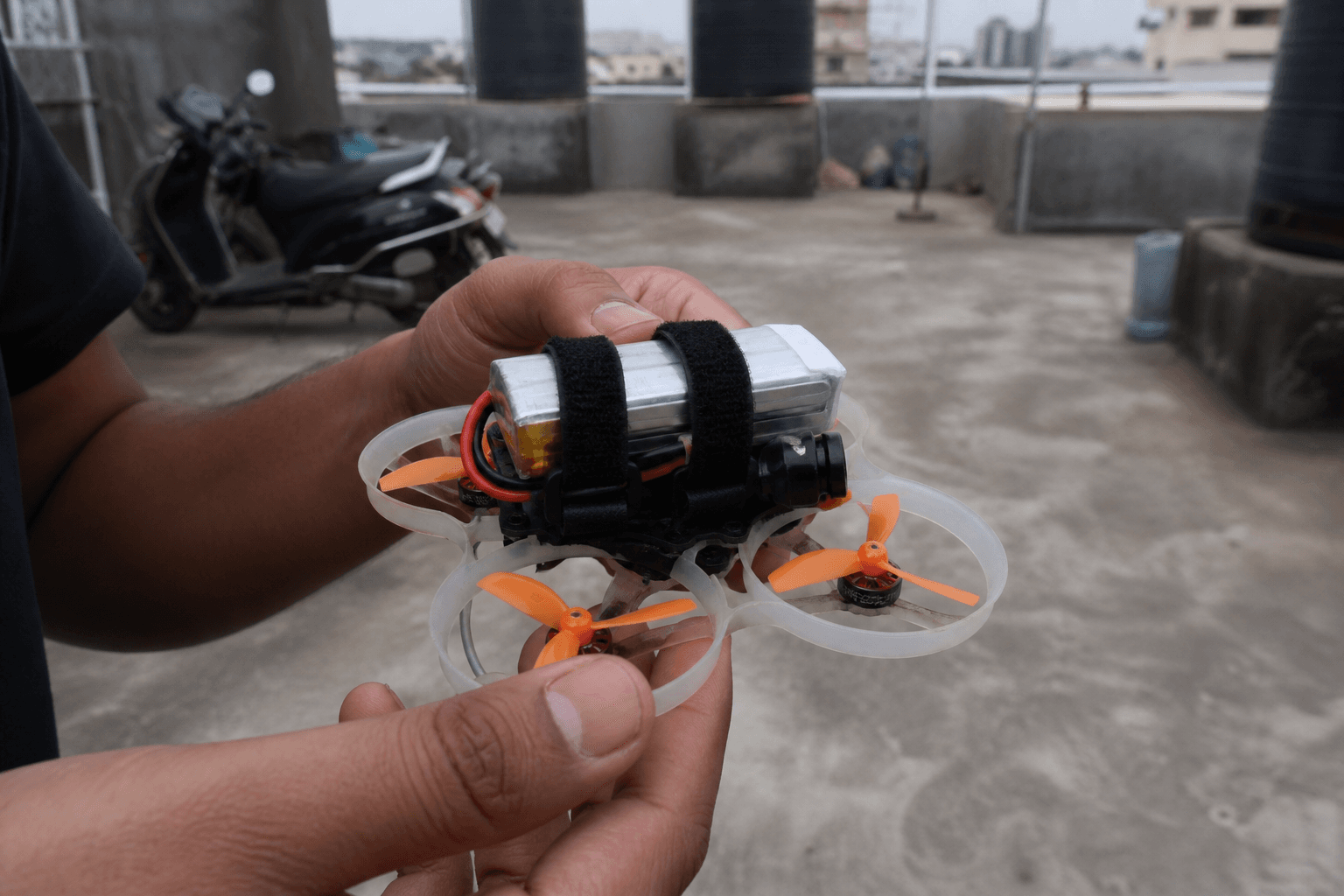
Move up when you are consistently bored, not occasionally frustrated:
- You fly full packs without crashing and want more authority in wind.
- You have outdoor space, a 2S 75/85mm is a park quad, not a living-room quad.
- You want to carry HD video weight eventually; 1S has no gram budget for it.
The 85mm 2S speed build recipe is the canonical step-up build.
Battery fleet implications
Cell count fragments your battery fleet, a 1S fleet and a 2S fleet do not mix, and both age. Before adding a 2S quad, budget for 5–6 dedicated packs and remember batteries ship surface-only in India, so the fleet split doubles your ordering lead time too. Chargers mostly cope: most whoop balance chargers handle 1S and 2S, but check before assuming, the parallel charging workflow needs same-cell-count boards.
The "1S but faster" trap
Chasing 2S feel on 1S with 25,000KV motors and heavy props mostly buys voltage sag, packs hit the soft floor sooner and the quad flies worse in minute two than a stock build. If you keep reaching for more punch on 1S, that is the signal to build a real 2S, not to burn 1S packs faster. C-rating myths covers why the pack, not the motor, is usually the limit.
Bench
1S and 2S packs, motors by KV, and 2S-rated AIO FCs are stocked at the Bench. The Grind Lab builder flags 1S/2S mismatches between motors, FC, and packs before you order.
See also
- FPV simulator before your first whoop, learn sticks before cell-count debates matter
- 65mm whoop build guide for India
- Tiny whoop BNF upgrades worth doing
- Betaflight tuning basics
FAQ
- Should I choose a 1S or 2S whoop first?
- Start 1S. It teaches throttle discipline with lower crash energy and fits Indian apartments and terraces better. Move to 2S after you can hover, figure-eight, and land softly without masking mistakes with punch.
- What is the real difference between 1S and 2S whoops?
- 2S roughly doubles pack voltage, which raises punch, weight, and crash energy. Motors and ESCs must be rated for the cell count - a 1S motor on 2S is a smoke event, not an upgrade.
- When does 2S make sense?
- After you already fly 1S well and need more outdoor wind tolerance or speed in parks. Expect higher noise, hotter packs, and slightly pricier crash tax.
Discussion
Comments aren't open on this post yet. Share it with your build group, or start a thread on X.