
Propwash tuning: practical D and feedforward

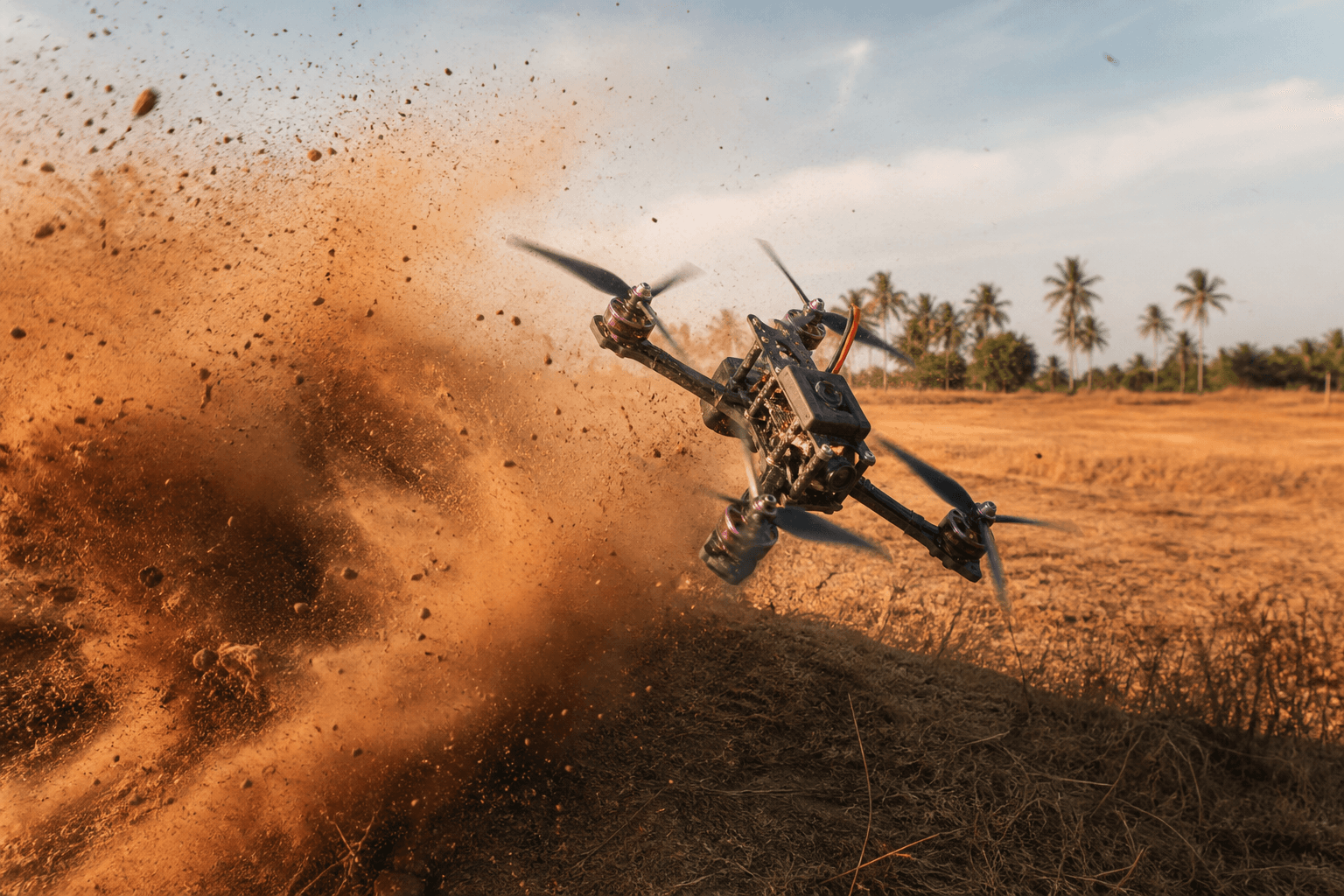
Propwash is the quad fighting its own turbulent air in hard turns, dives, and quick reversals. The prop disc moves through messy airflow, especially when throttle drops while the frame is still pitched hard. Pilots feel it as sink, bounce, rear washout, or a vague "it won't stay on the line." It is not always "too much P" and almost never fixed by copying someone's PID screenshot from Discord.
When NOT to propwash-tune
| Situation | Real issue |
|---|---|
| Problem only on one corner | Bent prop, weak motor, loose arm |
| Bad everywhere including hover | Mechanical or base tune, Betaflight basics |
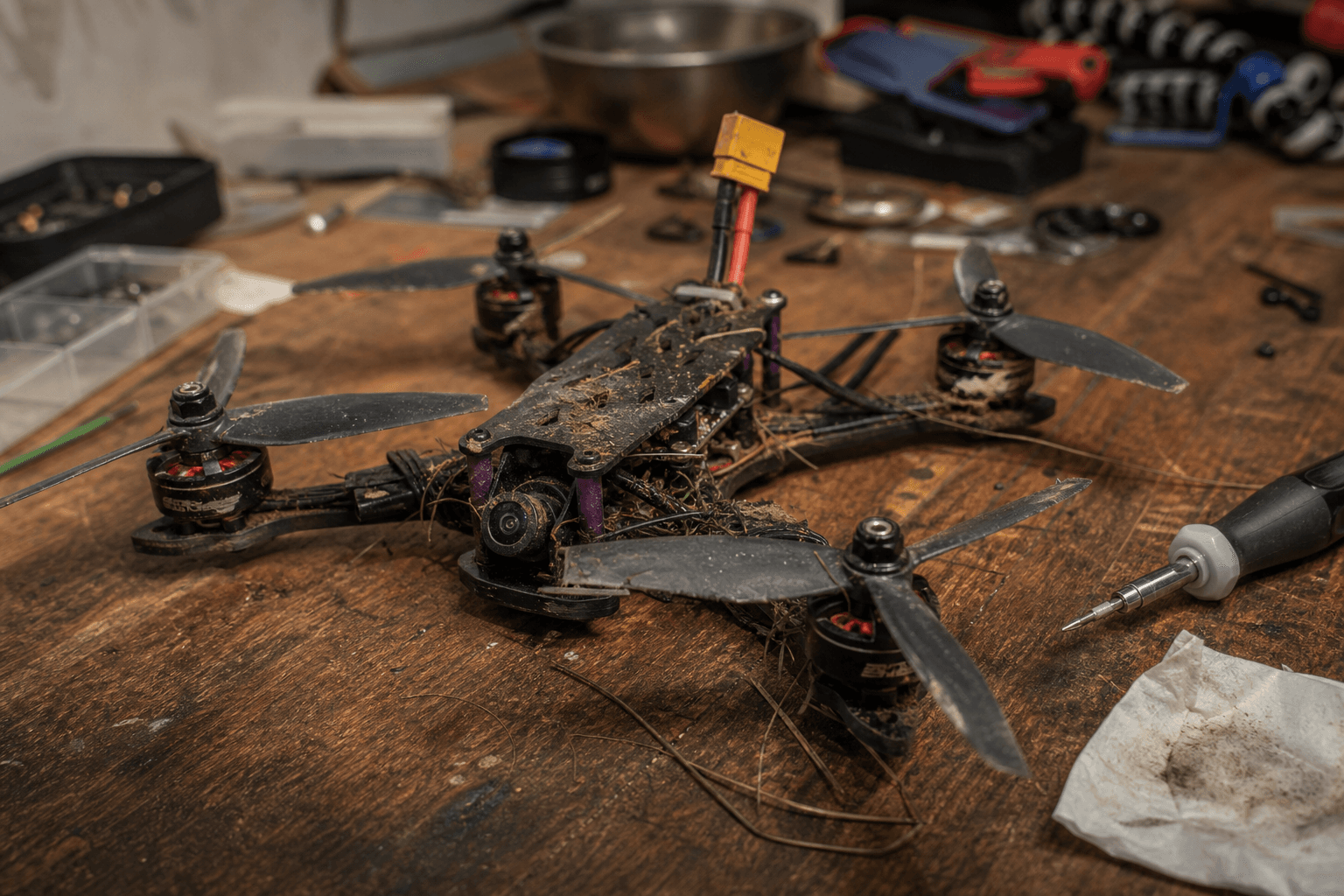
| Motors scorching | Heat / amp margin, lighter props, not more D |
| New heavy GoPro mount, no retune | Mass and resonance changed, remount or accept tradeoff |
| Only in DVR, fine in goggles | Camera mount flex, camera angle |
Propwash tuning assumes a quad that hovers clean and only misbehaves in aggressive maneuvers. If hover is wrong, fix hover first.
What propwash looks like in logs
In Blackbox, propwash often appears when:
- Throttle decays during a hard turn or flip exit
- Setpoint changes fast but gyro lags in the recovery phase
- D-term spikes if you already run high D, heat follows
Zoom to one power loop or split-S. If the ugly section does not overlap stick movement and falling throttle, you might be chasing the wrong problem.
Symptom map
| Feel | Direction to explore |
|---|---|
| Nose drops in fast descent | Throttle/mix habits; I term on pitch; tune after camera tilt |
| Oscillation in turn exit | D term or filtering; motor heat, hot climate |
| Sluggish correction, "mush" in flips | Feedforward up slightly; check over-filtering |
| Wash on quick reversals | Mechanical props; then FF and D together cautiously |
| Bounce after flip | D low or P high; also check prop bite and battery sag |
| Rear sinks in tight corner | Throttle management; pitch FF/I; not always PID |
Pilot input matters: propwash is physics plus tune. Dropping throttle too early in a corner guarantees sink, no FF saves bad timing.
Maneuver-specific notes
| Maneuver | Feel | Fix order |
|---|---|---|
| Power loop | Rear sink on exit | Throttle carry; then pitch FF/D |
| Split-S | Late roll catch | Roll FF, not yaw P |
| Quick 180 | Wash on reversal | Props; small roll FF; no mid-roll throttle chop |
Log one maneuver per session, not power-loop and split-S fixes in the same afternoon.
| Bad habit | Looks like | Fix first |
|---|---|---|
| Chop throttle in corner | Sink, rear wash | Carry throttle longer |
| Full idle in drop | Mush | Feather, not zero |
D-term in propwash
More D can calm oscillations in propwash recovery, it opposes rapid rate changes. But D adds noise sensitivity and motor heat. In Indian summer, aggressive D on a noisy gyro is how you touch-test ESCs.
| D change | Good when | Bad when |
|---|---|---|
| Small +D on pitch/roll | Clean gyro, bounce on exit | Already hot motors, noisy raw gyro |
| -D | Fine buzz after turns, heat | Sloppy overshoot everywhere |
| +D without filter check | Never | Always, pair with filter review |
Pair D changes with filter review, not blind +10 on all axes. RPM filter may let you run useful D with less heat if telemetry is solid.
Feedforward
FF pushes the quad toward stick intent faster, it anticipates setpoint change instead of waiting for error to build. Helps tracking in flips, snappy freestyle, and quick roll reversals.
| FF change | Good when | Bad when |
|---|---|---|
| Small +FF on roll/pitch | Sluggish snap, lag in logs | Already twitchy, noisy build |
| -FF | Oscillation on stick starts | Mush everywhere |
| Large +FF | Rarely | Masks bad P; worsens noise |
Too much FF feels twitchy and can worsen noise, especially on lightweight 3" rigs. FF is not "free snap."
I-term note: heavy I on pitch can fight dives, sometimes less I helps propwash in downward lines, sometimes you need I for camera-heavy noses. Change I only when logs show sustained offset, not momentary wash.
Process
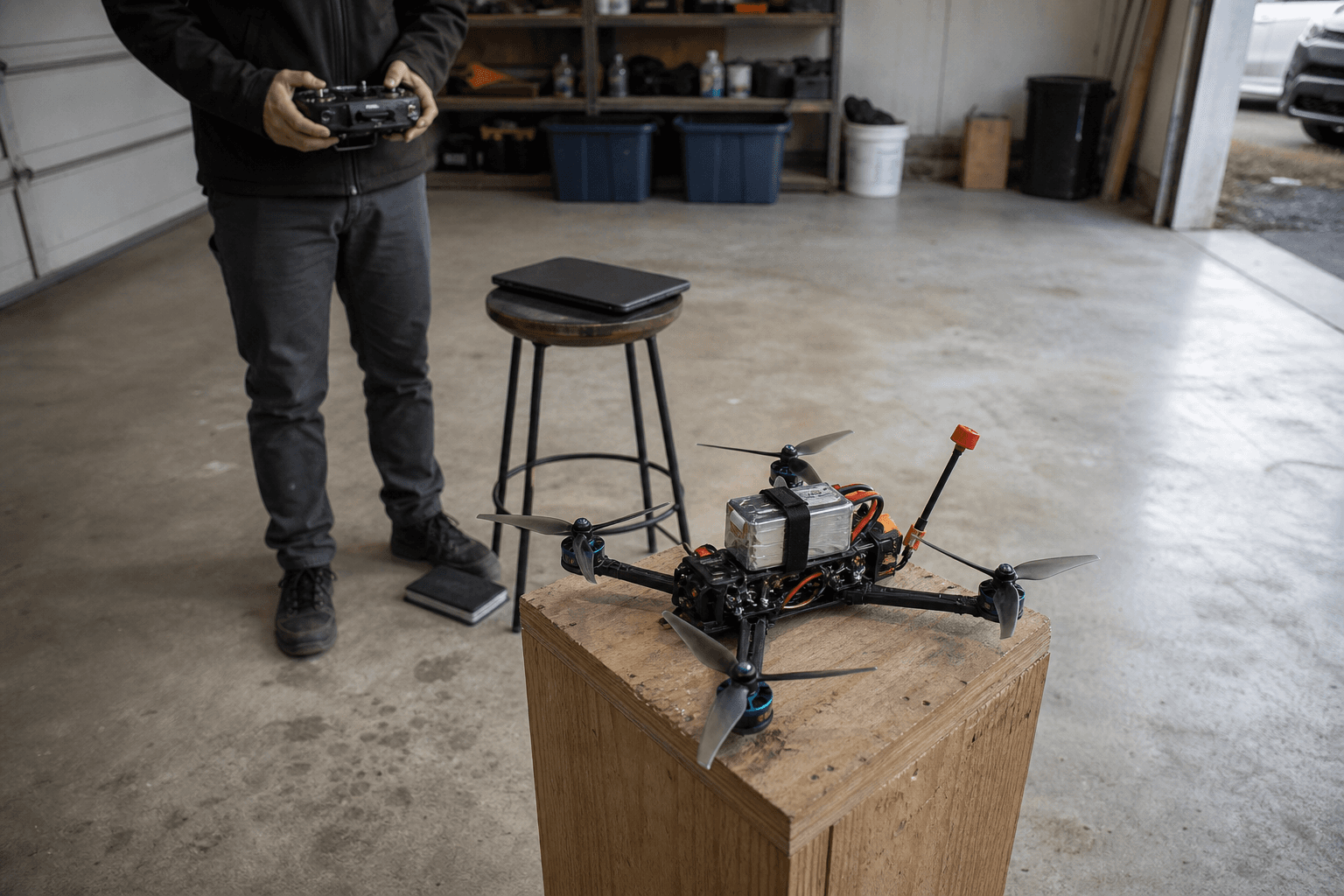
1. Confirm hover and cruise are acceptable
2. Log ONE maneuver, power loop or hard 180
3. Fix mechanicals (props, bolts, mounts)
4. Small FF bump OR small D bump, not both large at once
5. Same battery class, same spot, A/B same line
6. Stop after 2–3 changes per session, fresh eyes tomorrow
Rates interaction: high super rates demand faster tracking: FF often matters more than another P point. See rates and expo presets before blaming PID.
Common mistakes
- Copying "propwash tune" PID with different weight, props, or filters
- +15 D and +15 FF in one save
- Tuning propwash on pack 1 with a full battery, voltage sag changes line 2
- Ignoring throttle technique in dives
- Adding P when the issue is recovery oscillation (often D/filter)
When to stop
If the quad tracks well on 80% of your lines and only washes on absurd camera-tilt dives, stop. Perfect propwash-free freestyle on 5" is a gradient, not a checkbox.
If nothing improves after conservative FF/D and filters are sane, try slightly lighter props or accept that your motor KV / load is at the edge for that style.
Workflow after a crash
Hard hits change props and motors, propwash feel often drifts before hover feel does. After a session ender, see tuning after a crash before a propwash PID binge.
India field note
Afternoon heat pushes battery sag harder than cool morning packs, humid air is actually less dense than dry air at the same temperature, so monsoon humidity is not the propwash knob. A tune that cleared propwash on a fresh 6S at 28 °C may need conservative D or shade between packs at 40 °C, not necessarily more PID. Fly the same test line when validating.
If three conservative changes on the same line show no improvement, stop, check motor load or mechanicals. Propwash at amp headroom limits is physics, not a missing PID point.
Quick session checklist
□ Hover clean, motors cool
□ One test line named (e.g. "left power loop")
□ One knob per save, FF or D, not both large
□ DVR or Blackbox on that line only
□ Motor temp before next change
Magic numbers from forums are starting points for their weight and props, not yours. One maneuver, one knob, one log. Propwash tuning is iterative and boring; that is why it works.
Discussion
Comments aren't open on this post yet. Share it with your build group, or start a thread on X.